China Worker
中文
 
Username:
Password:

Iran: The largest mass movement since the 1979 revolution

Monday, 22 June 2009.

Since the declaration by sitting president Mahmoud Ahmadinejad that he had won the June 12 election, mass protests have followed one after the other in Iran
 
Kristofer Lundberg, from Offensiv (weekly newspaper of CWI Sweden)
 
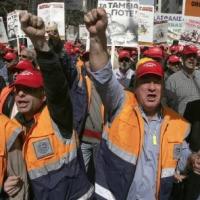
On Monday up to two million people lined the streets of the capital Teheran in what was the largest demonstration in Iran since the revolution of 30 years ago. Not since the Iranian revolution of 1979 have so many people dared to take to the streets. In an attempt to win some time and in the hope that the protest movement will ebb out the Guardian Council, a kind of religious overseeing government body, has promised a recount of certain electoral districts. But that little sweetener comes too late and is not enough to stem the people’s struggle. The Guardian Council’s announcement regarding a recount does, however, confirm that the protests have divided the ruling class.

The rulers are becoming evermore desperate and isolated – when dictatorial regimes come under the amount of pressure from the masses that Iran is currently witnessing they tend to split into two factions. One side saying ”more repression, if we introduce reforms they will gain self-confidence and we will have to deal with a revolution”, the other saying, ” we must introduce reforms, otherwise we face a revolution”

But during the struggle the demonstrations have been radicalised and Ahmadinejad’s main rival, Mir Hossien Mousavi, is not in control of the mass movement either. The violence of the regime’s supporters and state oppression as well as censorship have raised the stakes. At least seven protesters were killed on Monday with reports also stating that student protestors were killed the previous day. The Iranian masses have only their own strength and solidarity to rely on. In order to take the struggle to the next level, with general strikes and other mass actions to split the state’s and the islamists' forces, the workers and the impoverished need to organise themselves. What we are witnessing could be the beginnings of a fresh Iranian revolution, this time against the Ayatollahs’ dictatorship.

Working class struggle in Iran has escalated during the last few years. Since Ahmadinejad assumed office in 2005 thousands of workers’ protests have taken place. Workers’ leaders have been imprisoned and murdered, but despite such brutal oppression the protests have grown.

Mass protests and the economic crisis have driven a wedge into the ruling class, which was reflected in many ways during the election campaign. The presidential candidates openly criticised each other on live television while strong accusation of corruption and electoral fraud have been made.

This year’s election saw just four candidates approved by the 16-man Guardian Council – appointed by the Ayatollah Khamenei as the highest ruling body. The approved candidates were the sitting president Mahmoud Ah­madinejad, Mir-Hossein Mousavi who served as prime minister 1980-88, Mehdi Karroubi and Mohsen Rezai who previously led the infamous Revolutionary Guard.

The media had called it as essentially a choice between the ”reformist ” Mousavi and the conservative Ahmadinejad. All candidates were, however, approved by the regime and therefore no real reformist could have been allowed to stand. All four are rich politicians, loyal to the regime with 471 candidates prevented from standing and no women were allowed to participate. Mousavi is amongst those who believe that the regime will come under threat if more repression provokes greater numbers into turning against the dictatorship.

Mousavi has primarily succeeded in winning support among the urban middle-classes who have tired of Ahmadinejad. In reality this is not a signal of support for Mousavi but rather a hatred of Ahmadinejad.

Ahmadinejad entered the 2005 presidential race with populist promises of less corruption, lower inflation and unemployment and a fairer distribution of Iran’s oil resources. Since then poverty, inflation and corruption have increased, while oppression has simultaneously increased against the working class.

All of the candidates are accused of corruption in their own right – Iran is one of the world’s most corrupt countries, the Mullahs have spent their time thieving and taking bribes on a grand scale. The regime loyalists have secured their own wealth while poverty among workers and farmers has risen in the wake of the crisis. People are starving and it is not at all uncommon for an ordinary worker to have to hold down two jobs in order to survive. The average wage is not enough to meet a typical family’s food bill. The economic crisis has meant high unemployment and inflation.

Those are the decisive factors that explain the extent of the protests, although the election was the trigger. Even if Mousavi had stormed to victory the political difference would have been marginal. He himself is responsible for the massacre of tens of thousands of students during his reign as prime minister.

Besides, it is the Ayatollah Ali Khamenei who holds the real power. He has control of foreign and security policy, appoints supporters to key posts in the judicial system, state-run television, the military and the Guardian Council, which has the power of veto over the parliament’s laws and decides who may stand in elections. Khamenei first urged the people to respect the election result but has now been forced to agree to a partial recount.

Today’s struggle is for every fundamental democratic right: the right to freedom of association, the right to protest and strike, the right to organise as political parties or trade unions, for free and democratic elections.

In order to succeed, the fight for democracy must unite with the anti-capitalist struggle – for socialism. An programme of action is required for democratic rights as well as social improvements (improvements in working conditions, housing, education and health) and socialist production controlled by the workers and farmers. When the working class steps in the regime’s days are numbered, as demonstrated in the 1979 revolution.

Just as the regime of today, that of the Shah had a wide-reaching apparatus of control and oppression that steered the population’s lives in detail. The Shah had at his disposal all the weapons of repression: the military, police and a ruthless secret police. But these were literally crushed by the workers’ decisive struggle. The revolution of the poor and the working class in Iran toppled the Shah but was soon after hijacked by islamists – those who led the revolution were harassed, imprisoned, tortured, murdered or driven into exile.

A socialist breakthrough in Iran would ignite inspiration in workers and the impoverished in neighbouring countries. But a countrywide mass movement is necessary for this.

The socialist and communist parties in Iran should, together with other workers’ organisation and independent unions, unite on a common programme, with a view to co-ordinating protests across the entire country and, with a socialist plan of action set the goal of bringing down the mullahs’ dictatorship.

Post comment

You must be logged in to post comments

Receive regular updates from chinaworker in your mailbox

English articles
Enter your email address:


Chinese articles
Enter your email address:

Support our struggle for a democratic socialist alternative in China