
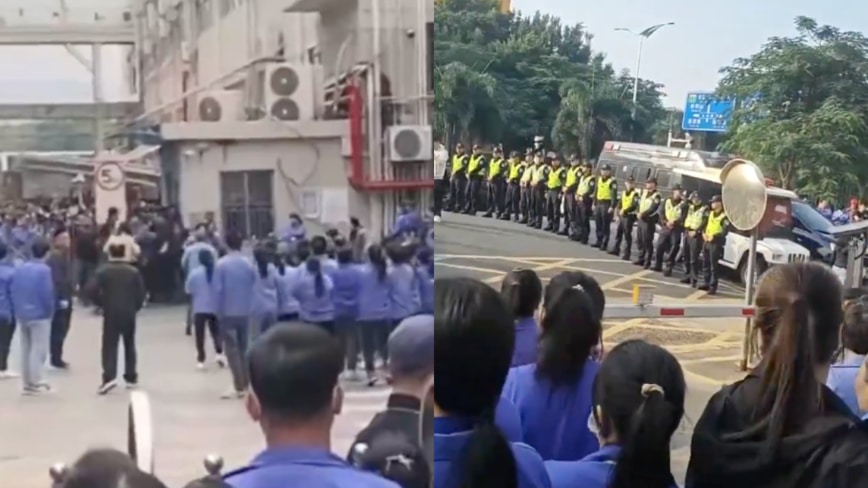
3,000 mostly women workers’ strike at Shenzhen factory against wage cuts as a disguised form of layoffs
Zhou Yi, chinaworker.info
A week-long strike by an electronics factory’s largely women workforce has captured attention across the country. The strike that erupted on 4 December at Yilisheng factory in Shenzhen, Guangdong, was against what was seen as a layoff in disguise. The factory is known as a “women’s kingdom” due to the high proportion of female workers. They demanded the restoration of overtime to guarantee their income or compensation based on their length of service.
Not only did all 3,000 workers at the factory initially go on strike, but after key strikers were arrested on the 9th, they quickly surrounded the factory gates, chanting slogans to demand their release. This pressure successfully forced the authorities to release them that evening.
The bosses issued an ultimatum that those who continued to strike would be considered as having resigned automatically and receive no compensation – a tactic that led some workers to return to work. But a large number continued the strike despite this intimidation.
Given that Chinese workers under the CCP’s authoritarian rule do not have the right to organise and act as a collective force, and that their struggles are often quickly crushed by the state apparatus, the Yilisheng workers’ strike, by sustaining action for a whole week, sets an important example. This also points to more, larger, and longer-lasting worker strikes in the near future as the economy sinks deeper into crisis.
Ultra-low wages and heavy overtime
Workers are demanding the restoration of “normal overtime” because, under the CCP’s authoritarian capitalism, standard hourly wages for manufacturing workers are generally so low that they’re barely enough to make ends meet, pushing workers to endure excessive overtime. Currently, Yilisheng workers receive an extremely low monthly take-home pay of less than 2,000 yuan (below Shenzhen’s statutory minimum monthly wage of 2,520 yuan).
Yilisheng Company manufactures electronic products such as Bluetooth headsets and once employed tens of thousands of workers. However, like countless other companies, the factory shrank in size with the capitalists chasing lower wages in other countries like Vietnam or relocating due to the trade war.
The company racked its brains to lay off employees, so in October of this year it cancelled the overtime system, pretending to comply with the legal working hours. But in fact it was to drastically reduce the monthly take-home pay of workers, “legally” forcing them to leave without having to pay compensation.
The day before the workers’ strike, the company announced that it would only provide a one-time living allowance of 200-300 yuan to employees who did not work overtime in December, but this was merely a drop in the bucket. These developments ignited the workers’ anger, and the strike broke out on the morning of the 4th, with thousands of workers gathering near the factory gates and blocking delivery trucks.
No to either evil
The working class should not be forced to choose between two evils, but should instead fight for a 40-hour workweek without loss of pay. This requires struggles demanding no layoffs, focusing on significantly increasing workers’ wages, and improving working conditions. If company owners refuse, arguing they won’t be able to make profits in the current economic crisis if such demands are met, workers must respond by demanding immediate transfer of the factory into public ownership. If the capitalists cannot safeguard jobs and wages, it is time for the working class to take over.
In 2010, workers at Guangdong automobile factories, through coordinated efforts across multiple factories, won pay rises of 35-40%. The workers also demanded the establishment of an independent union (a demand that ultimately wasn’t achieved, even though the CCP had vaguely and insincerely promised to strengthen workers’ collective bargaining rights). Capitalists and their authoritarian regime, out of fear, used substantial pay increases as a “carrot” to stifle workers’ calls for independent unions.
The CCP and its black so-called trade unions always side with the capitalists. Workers need independent trade unions to organise, gain strength, and fight against the capitalists; independent trade unions are also a crucial platform for working out the best demands. The determination of Yilisheng’s striking workers is admirable and deserves the support of all workers. For authoritarian capitalism, this is yet another ominous warning: the working class will not continue to tolerate further layoffs, pay cuts and the deprivation of basic rights.
The video below (9-10 December) is from the “YesterdayBigCat” channel. It shows Yilisheng workers’ strike has entered its second week, and workers’ unity forced authorities to release the arrested striking workers