Anna Barnett and Jesada Jitpraphakhan, Socialist Alternative (ISA in the United States)
(This article was first published on 30 January 2026)
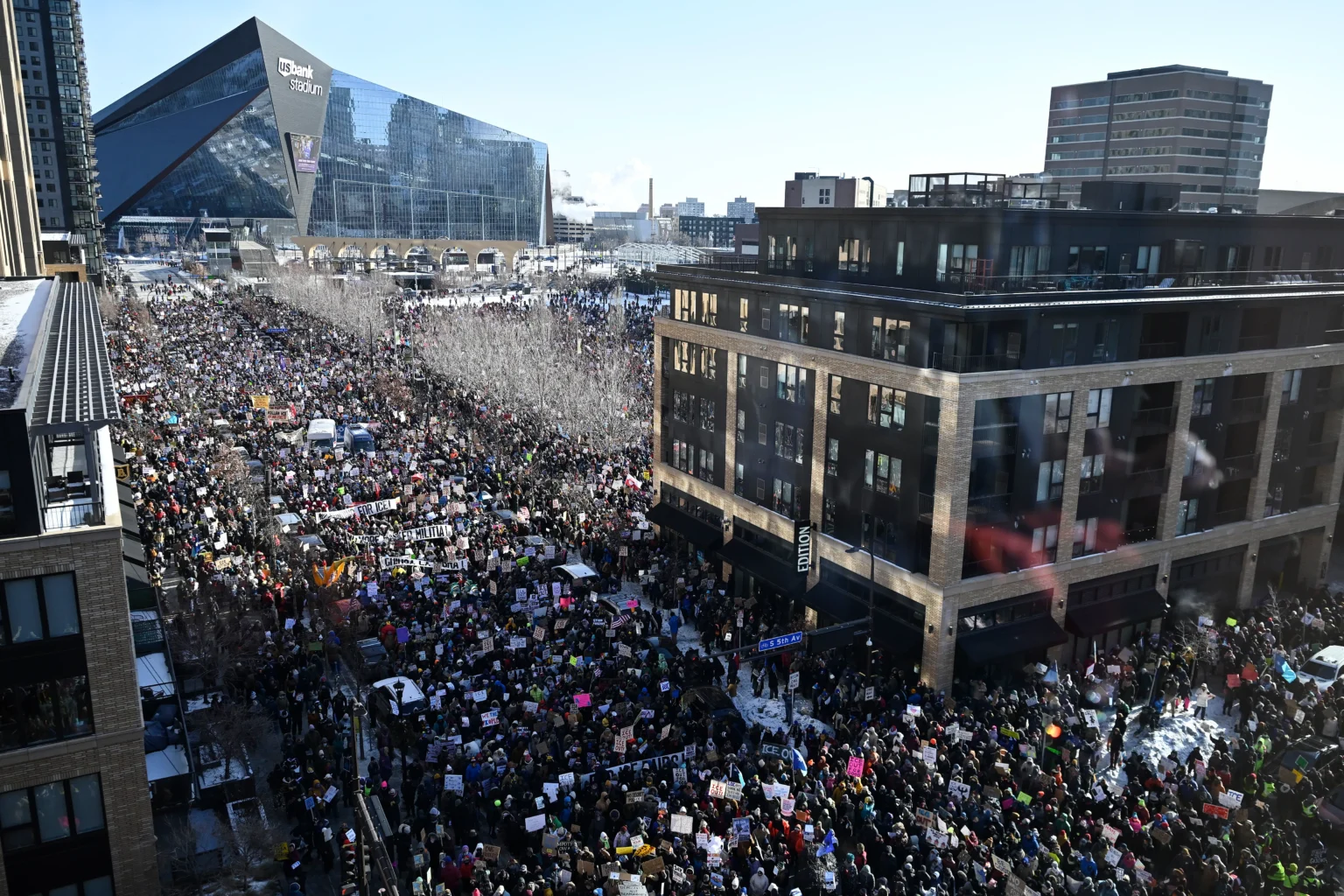
An epic battle has been unfolding in the Twin Cities, between ICE’s homicidal state terror on the one hand, and the ingenuity, determination, and solidarity of working-class people on the other. On January 23, tens of thousands did not go to work and instead rallied in downtown Minneapolis following ICE’s murder of Renee Good, sending a clear message that their brutal occupation will not be tolerated. Whole sections of the local economy ground to a halt, and hundreds of solidarity protests took place across the country. This was the first mass political strike against the Trump regime, a major leap forward in the fight against ICE, and a historic development in the class struggle in the United States.
Not even 24 hours later, a gang of Customs and Border Patrol (CBP) agents executed 37-year-old Alex Pretti, a nurse and member of AFGE Local 3669, who was peacefully observing ICE/CBP and helping someone who had been shoved by an agent. Another horrific, execution-style murder was captured on video and immediately defended by the Trump regime.
Trump’s unhinged escalation has been propelled by the regime’s need to decisively stomp out working-class resistance and pave the way for the unchallenged dominance of their reactionary agenda. This, they see as necessary to prepare US capitalism for a period of increasing global tumult and inter-imperialist conflict.
Already, the mass movement is having an impact, but the regime will not back down easily. Border Patrol commander Greg Bovino has been removed from his post and returned to El Centro, California. Trump’s new chief of operations in the Twin Cities, Tom Homan, also a vicious reactionary, speaks of a “drawdown plan.” We should celebrate the ouster of Bovino, but also be clear that this change of face is meaningless without an actual backdown on the reign of terror, and that we can have no confidence in Democrats like Governor Walz to negotiate on behalf of the movement.
The world is watching the developments in Minneapolis and the stakes are high. If federal agents leave the Twin Cities, they will be deployed elsewhere. The city-wide general strike set a bold and inspiring example for precisely what’s needed in the fight against ICE terror: mass, coordinated strike action. But we can’t be satisfied with a partial retreat or fake negotiations from Trump. That means we need to escalate, to strengthen and expand the strike in Minneapolis, and to spread it across the country.
ICE brutality sparks resistance
Over the past two months, “Operation Metro Surge” quickly became Trump’s largest and most brutal detention operation yet. The thousands of deployed federal agents far outnumber Minneapolis police, and have arrested over 3,000 people since December.
The episodes of brutality are seemingly unending. ICE agents reportedly smashed a car window to pull a pregnant woman out who they then dragged through the street. When bystanders tried to assist the woman by blocking ICE with their cars, the agents sprayed them with chemical irritants. A young US citizen was arrested, called racial slurs, brutalized to the degree that she got a concussion, and then detained for two days. Multiple children have been sent to detention centers including five-year-old Liam Conejo Ramos and two-year-old Chloe Renata Tipan Villacis, despite a court order to release her.
Trump’s attacks have spurred resistance in the Twin Cities on the highest level we’ve seen against Trump so far. Scenes of people rallying around an ICE raid to defend the person being detained are commonplace in the Twin Cities. Thousands carry whistles every day and dozens of neighbors flock to respond when they hear them. Sophisticated rapid response groups developed to monitor the movements of ICE agents, respond to raids and detentions, and document ICE arrests to provide legal support to those abducted. Neighborhood meetings attract hundreds.
The organic development of these networks shows the impressive creativity and dedication of working-class people who are doing whatever they can to defend their neighbors. Early on, they succeeded at stopping some detentions, but as the occupation multiplied in size and brutality, the mainly defensive strategy of rapid response groups began hitting its limits. To begin to push ICE into retreat, the movement would need to go on the offensive, namely through mass working-class action—the strike.
A historic escalation in the anti-Trump movement
In mid-January, SEIU Local 26 and an initial handful of union locals, immigrant rights, and community organizations in the Twin Cities made history calling for a one-day citywide strike against ICE. As the call gained momentum, a number of other unions joined as well as the AFL-CIO labor federations in Minneapolis and St. Paul.
This didn’t just drop out of the sky. At least 36 members of SEIU 26—which represents janitors, rideshare drivers, and more—and UNITE HERE Local 17 have been detained in the last year, many during this operation. This was a serious factor pushing these unions to escalate. The militant mood to fight back and the development of neighborhood organizing on a mass scale, which included many rank-and-file union members, created a dynamic that provided confidence to, and pushed, a section of the labor leadership into action. Organizing by rank-and-file workers, such as rallies to kick ICE off postal property organized by Build a Fighting NALC, a reform caucus in the National Association of Letter Carriers, also provided important pressure.
The morning of the strike, thousands protested outside Minneapolis-St. Paul International Airport against its role in over 2,000 deportations, blocking access to Terminal 1 for hours. Some 100 clergy were arrested in an act of civil disobedience. In deep sub-zero temperatures, over 50,000 marched through downtown Minneapolis (nearly 10% of the population of the Twin Cities) and converged on the Target Center arena to rally.
Much of the corporate media has been determined to paint January 23 as a shutdown driven by businesses, but this is a lie designed to obscure the distinct role of the working class in this fight. Sections of the local economy, especially union workplaces, were pressured to power down through the pressure of workers committed to the call for work stoppage. St. Paul School District was shut down while educators filled the streets. Without workers, theaters and museums shuttered. All UFCW union grocery co-ops (which employ hundreds of workers), and many coffee shops and restaurants shut their doors. At a unionized AT&T call center, it’s reported that up to 80% of workers called out. It was in the wake of this momentum, and often with active sympathy for the movement, that some small business owners did choose to close of their own accord. Of particular note immigrant-owned businesses including in Karmel Mall and Hmongtown Marketplace were shut down. In all, over 700 businesses were closed. While many large businesses such as Target and Amazon remained open, they were impacted by sickouts and in some cases depended on managers to open.
It is a characteristic of mass working-class movements, including general strikes, that the overwhelming power of the working class pulls sections of the middle class (primarily small business owners) to its side. When the momentum of class struggle is not with the working class, the middle class is often pulled more towards the big bosses, or, unconfident, is lulled into inaction. In a general strike, a work stoppage is generalized across multiple workplaces and multiple sectors of the economy, supported by a whole host of unions, and draws in big sections of the unorganized working class too. This is what took place in the Twin Cities.
Not all unions took the same approach to building for the strike: some locals held stewards meetings to organize maximum mobilization. Others took a more hands-off approach, leaving the decision on whether to participate up to individual members. There remained large parts of the economy which were not shut down, due to the timidity of some union leaders. But despite these weaknesses, the strike shook the Twin Cities and was the most substantial political strike in decades. The electrifying impact of the general strike across the Twin Cities metropolitan area shows the huge potential for future strikes to be even bigger. The cat is out of the bag and it’s not going back. Political strikes as a tactic to fight Trump and ICE are here to stay.
After the strike
The impact of the strike came quickly.
Trump and his inner circle first tried to blame Democrats for Pretti’s slaying, claiming that their unwillingness to collaborate with ICE is what led to these killings and that “the mayor and the governor are inciting insurrection.”
But it soon became clear that, for now, Trump had run out of room to blatantly escalate without risking an even bigger upheaval in society. At least a thousand Twin Cities residents occupied the site of the shooting all day. Pretti’s memorial vigil that night swelled to thousands. The call for another strike echoed loudly throughout the city. It was clear that the Twin Cities wouldn’t back down.
Over 60 Minnesota CEOs, of companies including Target, UnitedHealth, Cargill, General Mills, and 3M, issued an open letter calling for “an immediate deescalation of tensions.” Their letter did not even mention ICE, and they are clearly not motivated by any genuine concern for those being terrorized. What this signified is that a section of the capitalist class thinks Trump has gone too far. Mass strike action is the stuff of nightmares for the billionaires, and they knew that once this threat had been unleashed, it was much more likely to be used again, especially in the wake of Alex Pretti’s brutal murder.
A recent poll found that 46% of people support abolishing Immigration and Customs Enforcement, up from 27% in July. These shifts reflect that the reality of ICE’s brutality is setting in for a section of people, but also are an indication of the impact that the movement against the deportation machine has had in changing attitudes.
Many Republican lawmakers are now raising their discomfort with Trump’s excesses, and the GOP candidate for Minnesota governor has withdrawn from the race. Even prior to the strike and Pretti’s murder, developments in the Twin Cities were causing fractures and discontent in sections of state apparatus and parts of Trump’s base. Police officers have come out in opposition to the ICE operations, complaining that ICE is undoing years of work they’ve done to rebuild trust. ICE is having difficulty recruiting agents to the operation in Minneapolis, despite the incredibly lax hiring process. At least six prosecutors in the Minneapolis US Attorney’s office resigned after the administration demanded that rather than investigate the killing of Renee Good, they open up an investigation into Good and her background.
No trust in Walz & Frey
In the aftermath of Pretti’s murder and the ensuing backlash, Tom Homan has held discussions with Governor Walz and Minneapolis Mayor Jacob Frey. While weeks ago, Frey was adamant that ICE needed to “get the fuck out of our city,” this was always theater. If a deal is reached, it will certainly be a rotten compromise. Trump is feeling the heat of the movement and understands that at this stage, further escalation could be dangerous, but a full withdrawal would cause him to lose face. Trump’s demands—which would essentially entail a full scrapping of all “sanctuary city” policies—are a clear indication that he’s prepared to drive a hard bargain. Most recently, Homan reported agreement from Democratic state Attorney General Keith Ellison that county jails can notify ICE of the release dates of immigrants. Homan reiterated that regardless of what a “drawdown” looks like, “we are not surrendering the president’s mission on immigration enforcement.”
This racist, violent, authoritarian regime cannot be reasoned or negotiated with. It only understands power and force. It is only the united mass action of the January 23 strike, and the threat to profits posed by the specter of continued escalating strikes, that have forced Trump to act more cautiously. Escalation along these lines is the only way to stop Trump’s deportation machine. Instead, Walz cheers from the sidelines, telling Minnesota how proud he is, and signaling that he can take it from here. Walz has activated the National Guard, but we should have no illusions that they will be a counter to ICE. Walz will not direct the Guard—the same force that was sent in to crush the George Floyd uprising—to defend the movement, but primarily to contain the movement and quell protests. If such orders are issued, Guard members should disobey.
The dead-end Democrats
Even now, the Democratic Party is not fully united in its opposition to ICE. Squabbles ensue over whether ICE should be abolished or merely reined in (with Frey still supporting the latter). Seven Democrats in the House voted to increase DHS funding by an additional $65 billion, including $10 billion more for ICE. Others have made calls for “better training” and bodycams. But the issue is not bad training: this is a conscious offensive by the Trump regime to terrorize immigrants and send a message to the working class as a whole. Despite the handwringing, the Democrats themselves actually laid the groundwork for the regime’s war on immigrants. The opposition to the slogan “Abolish ICE” from sections of the party is not surprising considering the Democratic Party has never really opposed the deportation machine, only what they see as its excesses.
Since their last vote, Senate Democrats had laid out new conditions for voting to fund DHS—a stop to ICE patrols, unmasking ICE agents, instituting a code of conduct and independent investigations of violations. Yet days later, rather than trigger a government shutdown, Senate Democrats reached a deal with Republicans to fund DHS for two more weeks while continuing to negotiate reining in immigration agents, completely surrendering the little leverage they have within the halls of Congress. But even their requests—such as bodycams and documentation for arrest warrants—are completely insufficient in the first place. ICE is a fundamentally reactionary force that needs to be abolished, though we should be clear that this would still not mean an end to the deportation machine.
Many Democratic Party politicians in other cities have made a big show of telling ICE to stay away. The movement needs to put them in the hot seat and demand that these statements be backed up with real action, including kicking ICE and DHS out of courthouses, keeping them off of city-owned property, and stopping all data sharing between police or social services and ICE. There should be concrete measures taken to protect undocumented people like eviction moratoriums and free grocery delivery. Genuine opposition to ICE has to involve actively building the resistance—mobilizing supporters to protests and organizing for strike action, rather than trying to put the brakes on the movement with empty speeches and legal challenges.
The reality is, the Democratic Party is not an effective vehicle to fight back. They won’t call for the type of tactics and movement necessary to stop Trump in his tracks because such a movement could get out of their control and threaten their rule as well. The strength of the strike and protest on January 23 came from the organization of working-class people in their unions, workplaces, and communities, not the Democratic Party. Our movement needs to be fully independent from the Democratic Party and rooted in the power of the working class. We need a new workers’ party independent of big business, which could in moments like these serve as a launchpad to bring together all the different elements of our movement—including unions, immigrants rights groups, students, rapid response groups, and mutual aid efforts—and coordinate the way forward.
We need a nationwide strike to shut down the deportation machine
Since last year, Socialist Alternative has been consistently pointing towards the necessity of strike action and for the labor movement to step decisively into the ring in the fight against Trump. Strike action is powerful because it shuts down business as usual and hits Trump and his billionaire friends where it hurts: their profits.
Tens of thousands of people in Minnesota now have the experience of taking collective action with their coworkers and neighbors. This needs to be seized on to build for another strike—wider, deeper, and capable of shutting down all profits. Warehouses, factories, public transportation, and airports are key profit-making centers and economic chokepoints that would need to join the strike. But the Twin Cities can’t be left to fight alone: the strike must spread nationwide. Every city invaded by ICE should take up the strike tactic to beat back Trump’s offensive. But more than that, we need a coordinated nationwide strike action with the organized labor movement in the driver’s seat.
A call by student organizations at the University of Minnesota for a nationwide shutdown on January 30th went viral, and quickly gained the support of hundreds of organizations nationwide. Socialist Alternative has joined this call, and is building for student walkouts, as well as some workplace actions. Days of action like these are crucial for keeping up the pressure, but they won’t be able to reach their full potential without the weight of sections of the organized labor movement behind them. The leaders of major unions in the US have a serious responsibility to take the lead in coordinating the strongest possible strike action, because they have the power to shut down entire workplaces without organizing from square one. Where labor leaders are dragging their feet, rank-and-file workers need to apply pressure. Anti-ICE union members can propose resolutions (contact us for a template resolution) at upcoming union meetings pledging organized non-cooperation with ICE, make plans for the defense of immigrant coworkers, and initiate and join mass actions.
But it can’t stop there. A nationwide strike must also include serious organizing of nonunion workers (who unfortunately make up the majority of the workforce). This can also lay the basis for new union drives in many workplaces and build the labor movement, and there are already signs of this beginning in the Twin Cities.
A bigger strike will require going beyond sickouts, including defying anti-union no-strike clauses. In moments like these, it becomes quite clear that the laws serve the billionaires’ system, not working people. The right to strike, the right to a union, and more, were not always protected by law, but were won through mass collective action that took place in defiance of the law. Trump has shown he doesn’t care about the law, because he wields power. But the power of the united working class can trump both the president and what’s written on paper.
Strike action and civil disobedience can also be built in neighborhoods, on every block, linked to walkouts in every school and campus. In the Twin Cities in the lead-up to the strike, a number of neighborhood groups came together for a citywide assembly, an important example of the type of organization needed to step up the fight against ICE. Socialist Alternative members were able to propose a “work stoppage committee,” with representatives from rapid response groups who were interested in building for the January 23 strike action in their neighborhoods. This is the type of organizing we need in every city. Strike organizing should become a key priority of neighborhood groups, training activists to bring the strike call into their workplaces. Unions, immigrants rights organizations, rapid response networks, and socialist organizations should come together for conferences of resistance to discuss and debate the way forward and map out next steps.
The movement across the country needs to take its cues from the struggle in Minneapolis. We need to build for a strike nationwide that can shut down this murderous regime and its terror against our communities.
End terror against immigrants for good—Fight for socialism!
Divide-and-rule terror is an age-old tactic of the capitalist class, and the Trump regime has distilled it to its most grotesque form. Trump, presiding over the crisis of US capitalism, is using the scapegoat of “illegal alien criminals” to distract a section of the population from the problems he’ll never be able to and has no desire to solve.
It could not be more clear that this crisis is baked into the capitalist system and working-class people are the ones who pay the price. A system that locks up children, drives working-class people into hiding, and shoots people point blank in the streets cannot be tweaked. Racist violence and authoritarianism have not come out of nowhere—they’re an outgrowth of a system rotting from the inside. This is why Socialist Alternative fights for revolutionary change. We fight for socialism, which means reorganizing society on the basis of the needs of the masses of workers and the poor in the US and internationally, not in the interests of a handful of ruling elites.
Socialist Alternative calls for:
- ICE out of Minnesota and everywhere! We need bigger, stronger, and deeper strike action in the Twin Cities and a nationwide strike, with unions leading the way, to shut down Trump and ICE!
- Jail all killer ICE/CBP agents!
- End all deportations! Immediate, unconditional legalization and equal rights for all undocumented immigrants, regardless of their job status.
- Abolish ICE and put the deportation machine’s $170 BILLION budget toward funding public schools, expanding programs like SNAP, and building high-quality affordable housing.
- Shut down all for-profit detention centers! 32 people died in ICE custody in 2025: Put GEO Group and CoreCivic out of business!
- Eviction moratoriums in all cities invaded by ICE/CBP! Thousands of workers targeted by ICE are in danger going to work, and will find it hard to make rent.
- The Democrats can’t and won’t stop Trump and ICE: we need a new party for working people!
- Build a movement against the destructive policies of US imperialism around the world that drive working-class people to flee their home countries. We need an international struggle for socialism to fight for a world that works for us, not the ruling elite.