Imperialism and the quest for global hegemony is behind the rare earth battle
Li Yong and Moby, chinaworker.info
Rare earth elements are considered China’s most powerful trump card in the US-China imperialist trade war. They are essential in the manufacture of advanced medical equipment, cell phones and A.I. chips. Most importantly for the capitalists, the world’s biggest growth industry – armaments – needs rare earth metals. A single American F-35 fighter jet contains 417 kilograms of rare earths.
How was China’s rare earth dominance forged and who paid for it? Rare earth elements (REE) refer to a set of 17 elements (such as cerium, dysprosium and scandium) that in fact are not rare; some REEs are even more abundant than common metals such as copper and lead. However, they are generally dispersed and difficult to refine. Extracting them is usually accompanied by alarming levels of pollution.
China is home to approximately 50% of the world’s proven rare earth reserves, has 90% of the world’s refining capacity, and, at its peak, its total output accounted for over 90% of the world’s total, although last year it accounted for approximately 64%.
China’s rare earth industry emerged in 1985 when the so-called Communist Party (CCP), already on the road to capitalism under Deng Xiaoping, offered tax rebates on rare earth exports to boost foreign exchange earnings. With virtually no environmental regulations in place, illegal mining, refining, and even smuggling of rare earth deposits proceeded openly.
Under these circumstances, environmental damage was disregarded by the authorities during mining and waste disposal. Worker safety was ignored and tariffs of course did not apply to smuggling. As a result, the price of finished rare earth products in China was only one-third or even one-fifth of that in the United States. By shifting costs onto the environment and workers, who lacked and still lack even minimal democratic rights to organise unions and fight for better protection, China virtually monopolised the rare earth market.
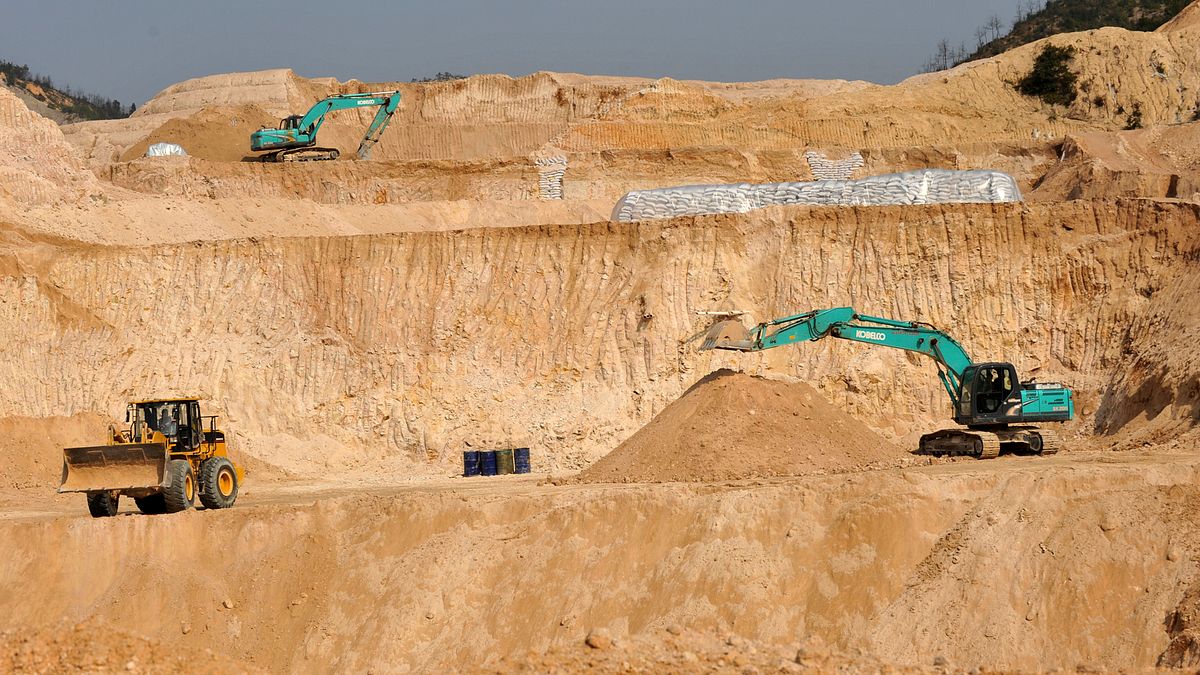
But what price did the Chinese masses and the poor pay for this? Initially, the most common method for refining rare earth elements in China was to first mine the soil containing rare earth ions, and then repeatedly irrigate and soak the ores with large amounts of acidic solution to displace the rare earth ions. This resulted in the mountains being devastated by the mining, vegetation being completely eradicated, and the acidic solution seeping into the soil in large quantities, turning the entire area into wasteland with almost no chance of natural recovery. These waste solution also flowed into groundwater and rivers, destroying fish and plants.
Later, the CCP promoted the so-called “in-situ leaching”, which involves drilling holes in mountains, injecting acidic solution to allow rare earth minerals to be replaced underground, and then pumping the solution back out. While this avoids completely altering the mountain’s appearance, only a portion of the injected solution is pumped back; the rest seeps into the ground. This method is the equivalent of “sweeping the garbage under the rug”. The pollution becomes more insidious and long-lasting. This has been summarised in the widely quoted “fact” that “for every ton of rare earth elements refined, 2,000 tons of toxic waste is generated,” although this is actually an underestimate as it only refers to the processing stage, while the initial mining and extraction also have significant environmental impacts. Illegal mining creates even more destructive effects.
Cancer villages
In 2012, the National Business Daily reported that in Jiangxi Province, local villagers suffered crop failures due to rampant pollution from rare earth mining. Although the villagers deeply resented the mining operations that were destroying their villages, they were forced to join the illegal mining operations to survive. They used rudimentary methods in their backyards to refine the minerals for a meagre income, but due to the lack of any protective measures, their health was severely damaged. Meanwhile, the local government, bribed by mine owners, turned a blind eye to this pollution.
The industry has given rise to “cancer villages” with elevated levels of cancer and birth defects, which have long been covered up by authorities. According to media reports, also in 2012, in Ganzhou, Jiangxi Province alone, there were as many as 300 abandoned rare earth mines, with 200 million tons of tailings and waste residue, and nearly 100 square kilometres of forest destroyed.
In the suburbs of Baotou City, the second largest city in Inner Mongolia, there is a notorious “tailings pond” called Black Lake. It is not a natural lake, but rather formed by wastewater discharged from surrounding mines. The “lake” is devoid of any life, and the surrounding area is barren for miles around. Nearly every household in the vicinity suffers from various rare and difficult-to-treat diseases, including chest and lung diseases and osteoporosis.
China’s “competitive advantage” in the international rare earth market, characterised by low prices, are entirely built on the bloody exploitation of the forcibly non-unionised working class and the environment. According to Bloomberg in an article from January 2011, the waste gases (including deadly fluorine and sulfur dioxide) produced annually by China’s rare earth industry are more than five times the total emissions from all mining and refining plants in the US. A research report in the Journal of Environmental Hygiene (3 July 2023) indicates that rare earth workers have lower white blood cell counts, neutrophil counts, and monocyte counts than normal, typically reaching their lowest levels within six years of starting work. Furthermore, many workers suffer from pneumoconiosis, chemical poisoning, and leukaemia caused by exposure to radioactive materials.
The environmental destruction in rare earth-producing regions may take up to 300 years to repair and some destruction may be irreversible, according to China’s Ministry of Ecology and Environment in a 2014 report. Yet, in this frenzied slaughter of all life on the land, capitalists have reaped unimaginable profits, while the CCP proudly regards it as a weapon against American imperialism. Xi Jinping’s family, principally through his older sister Qi Qiaoqiao, owns a lucrative share of China’s rare earth business. This is part of the Xi family’s huge business empire, which was worth around $1 billion USD in 2012 according to a Bloomberg report (More up to date information is unavailable due to even more stringent censorship and Western media’s fear of antagonising the CCP).
Militarism and imperialist conflict
In the past, Western capitalist countries were happy to outsource these “dirty jobs” to China, enjoying cheap rare earth resources without worrying about environmental regulations, workers’ rights, or media scrutiny. However, with escalating US-China imperialist conflict and the crucial role that rare earths play in modern militarism, the US and other Western countries have been forced to speed up plans to develop rare earth supply chains independently of China. Trump signed new rare earth deals with Australia, Japan and Malaysia in October.
But almost all experts agree that this shift away from China’s rare earths by the US and its camp will take at least five years, possibly much longer, and will require vast sums in investment, which – much like the rapid growth of military budgets – will put healthcare, education and other social services, as well as already inadequate climate finding, in the firing line for draconian cuts.
The workers’ movement in all countries needs to take up the call for public ownership under democratic working class control of the rare earth industry, and a democratic plan to develop them only for peaceful technologies. In the hands of the corrupt, belligerent and militaristic capitalists on all sides of the imperialist bloc conflict, the struggle over these vital minerals will only entail more suffering and destruction for working-class people.