100,000 set to march against Hong Kong’s undemocratic government
Wednesday, 1 July 2009.
Alarm in Beijing over Hong Kong’s deepening government crisis and growing demands for universal suffrage
Vincent Kolo, chinaworker.info
Demands for democracy are shifting into ‘storm force’ in Hong Kong on the twelfth anniversary of its return to China. Today’s (1 July) pro-democracy march from Victoria Park at 3pm is set to be the biggest for several years. Protests against the Beijing-picked government’s backtracking over introducing universal suffrage will be joined by other grievances from trade unions over pay freezes or cuts, bank victims’ groups, and others reeling from the effects of the global capitalist crisis. On all these issues the government of Donald Tsang Yam-kuen has shown itself to be extremely faithful to the interests of its ‘electors’ - the tiny group of Beijing-friendly tycoons and business leaders who dominate an 800-strong selection committee that chooses the government Chief Executive. Behind a smokescreen of economic ‘stimulus’ measures the government has been ‘stimulating’ its friends in big business while shifting the burden of the crisis onto the poorest sections of society.
The Chinese regime is clearly alarmed about the expected high turnout for today’s march, which can further weaken Tsang’s position and encourage workers, youth, and other groups to fight for their interests. Organisers are hoping that as many as 100,000 people will take part. Even the police are expecting about 90,000 people to turn out
“This year is the 60th anniversary [of the establishment of the People’s Republic of China]. They [Chinese leaders] are afraid they will lose face if many people hit the streets,” Democratic Party chairman Albert Ho Chun-yan, one of the organisers, said at a press conference yesterday.
Capitalist crisis
This year, the march has taken on a new role as a general focus for social grievances and ‘livelihood issues’ amid a severe recession (the economy slumped by 7.8% in the last quarter). Many public sector unions have decided to join the march and use it as a platform for their case as the government imposes a pay freeze, or pay cuts for better paid grades, and contracts out more and more public services. The anger in this sector is evident by the threat of the police to stage a protest march on Sunday. This is because a pay review that awarded the police a new pay structure has been put on ice by Tsang’s government until the “economy improves”. To this standard argument of capitalist politicians we would reply: Improves for who? The Hang Seng Index (main stock market index) has surged 28 percent this year and a new, but short-lived, bubble of speculative gains is benefiting banks, hedge funds and all the other shady and unaccountable financial institutions that created the present crisis. Bank profits are again heading upwards - but these are not frozen ‘until the economy improves’!
The police protest was narrowly averted by a hastily convened mass meeting at which Hong Kong’s Police Commissioner pledged his support - in vaguely formulated terms - for pay rises. The appearance of concessions to the police will surely encourage protests from other ‘disciplined services’ - the fire brigade, customs and immigration, prison services - also facing a pay squeeze under the government’s so-called crisis-fighting measures. A Chinese government analyst told the South China Morning Post that the regime viewed a possible police officers’ march as a “destabilising” factor in Hong Kong.
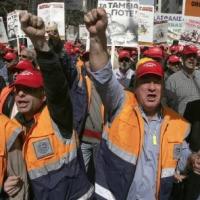
“The government has led the way in exploitation of workers by outsourcing our positions. We have to stop this by marching,” declared Tse Tin-wing, representing the postal workers. Two postal unions announced they would mobilise hundreds of their members to march today. They will be joined by several civil service unions affiliated to the Confederation of Trade Unions. Also participating will be several hundred victims of the Lehman Brothers ‘minibond’ scandal, which wiped out the savings of around 48,000 people in Hong Kong when the U.S. bank went bankrupt last September. They accuse the government of laxity and inaction over widespread abuses by major banks, more than 20 of which participated in the sale of these high-risk and now worthless financial products.
Effects in mainland China
The Hong Kong march will be closely watched, and not just by the government, in mainland China. Not coincidentally 1 July is also the day the Chinese dictatorship increases its internet controls by ordering that all personal computers sold from today must have the blocking programme Green Dam pre-installed. This order has drawn widespread protests, and rightly so, but will ultimately fail to block China’s more than 300 million internet users. Another unmistakable sign of greater political repression is the formal charging of democracy activist Liu Xiaobo, after seven months of arrest, with trying to ‘subvert the state’. Liu is the main author of the Charter 08 manifesto against one-party rule. His case will be taken up actively on the Hong Kong demonstration. While chinaworker.info does not support Liu’s pro-capitalist economic views, we unreservedly call for his release and for an end to the persecution of regime critics.
This year, especially in the wake of the largest ever 4 June candle-light vigil (for victims of the 1989 Beijing massacre), there is a heightened consciousness in Hong Kong about events in mainland China and the direct impact they have on the future of Hong Kong. Speaking on the Liu Xiaobo case, Civic Party politician Claudia Mo Manching said “If we don’t speak up, tomorrow’s Hong Kong may just become today’s mainland.” This is undoubtedly true, but the point is to fight to change mainland China. The struggle that has already begun in Hong Kong cannot be won in Hong Kong alone, but must spread to the mainland, into a mighty mass movement for full democratic rights, including democratic control over the big companies and banks whose profits rampage is wrecking the economies of Hong Kong, China and the world.
Further reading: chinaworker.info leaflet for 1 July march for democracy
Vincent Kolo, chinaworker.info
Demands for democracy are shifting into ‘storm force’ in Hong Kong on the twelfth anniversary of its return to China. Today’s (1 July) pro-democracy march from Victoria Park at 3pm is set to be the biggest for several years. Protests against the Beijing-picked government’s backtracking over introducing universal suffrage will be joined by other grievances from trade unions over pay freezes or cuts, bank victims’ groups, and others reeling from the effects of the global capitalist crisis. On all these issues the government of Donald Tsang Yam-kuen has shown itself to be extremely faithful to the interests of its ‘electors’ - the tiny group of Beijing-friendly tycoons and business leaders who dominate an 800-strong selection committee that chooses the government Chief Executive. Behind a smokescreen of economic ‘stimulus’ measures the government has been ‘stimulating’ its friends in big business while shifting the burden of the crisis onto the poorest sections of society.
The Chinese regime is clearly alarmed about the expected high turnout for today’s march, which can further weaken Tsang’s position and encourage workers, youth, and other groups to fight for their interests. Organisers are hoping that as many as 100,000 people will take part. Even the police are expecting about 90,000 people to turn out
“This year is the 60th anniversary [of the establishment of the People’s Republic of China]. They [Chinese leaders] are afraid they will lose face if many people hit the streets,” Democratic Party chairman Albert Ho Chun-yan, one of the organisers, said at a press conference yesterday.
Capitalist crisis
This year, the march has taken on a new role as a general focus for social grievances and ‘livelihood issues’ amid a severe recession (the economy slumped by 7.8% in the last quarter). Many public sector unions have decided to join the march and use it as a platform for their case as the government imposes a pay freeze, or pay cuts for better paid grades, and contracts out more and more public services. The anger in this sector is evident by the threat of the police to stage a protest march on Sunday. This is because a pay review that awarded the police a new pay structure has been put on ice by Tsang’s government until the “economy improves”. To this standard argument of capitalist politicians we would reply: Improves for who? The Hang Seng Index (main stock market index) has surged 28 percent this year and a new, but short-lived, bubble of speculative gains is benefiting banks, hedge funds and all the other shady and unaccountable financial institutions that created the present crisis. Bank profits are again heading upwards - but these are not frozen ‘until the economy improves’!
The police protest was narrowly averted by a hastily convened mass meeting at which Hong Kong’s Police Commissioner pledged his support - in vaguely formulated terms - for pay rises. The appearance of concessions to the police will surely encourage protests from other ‘disciplined services’ - the fire brigade, customs and immigration, prison services - also facing a pay squeeze under the government’s so-called crisis-fighting measures. A Chinese government analyst told the South China Morning Post that the regime viewed a possible police officers’ march as a “destabilising” factor in Hong Kong.
“The government has led the way in exploitation of workers by outsourcing our positions. We have to stop this by marching,” declared Tse Tin-wing, representing the postal workers. Two postal unions announced they would mobilise hundreds of their members to march today. They will be joined by several civil service unions affiliated to the Confederation of Trade Unions. Also participating will be several hundred victims of the Lehman Brothers ‘minibond’ scandal, which wiped out the savings of around 48,000 people in Hong Kong when the U.S. bank went bankrupt last September. They accuse the government of laxity and inaction over widespread abuses by major banks, more than 20 of which participated in the sale of these high-risk and now worthless financial products.
Effects in mainland China
The Hong Kong march will be closely watched, and not just by the government, in mainland China. Not coincidentally 1 July is also the day the Chinese dictatorship increases its internet controls by ordering that all personal computers sold from today must have the blocking programme Green Dam pre-installed. This order has drawn widespread protests, and rightly so, but will ultimately fail to block China’s more than 300 million internet users. Another unmistakable sign of greater political repression is the formal charging of democracy activist Liu Xiaobo, after seven months of arrest, with trying to ‘subvert the state’. Liu is the main author of the Charter 08 manifesto against one-party rule. His case will be taken up actively on the Hong Kong demonstration. While chinaworker.info does not support Liu’s pro-capitalist economic views, we unreservedly call for his release and for an end to the persecution of regime critics.
This year, especially in the wake of the largest ever 4 June candle-light vigil (for victims of the 1989 Beijing massacre), there is a heightened consciousness in Hong Kong about events in mainland China and the direct impact they have on the future of Hong Kong. Speaking on the Liu Xiaobo case, Civic Party politician Claudia Mo Manching said “If we don’t speak up, tomorrow’s Hong Kong may just become today’s mainland.” This is undoubtedly true, but the point is to fight to change mainland China. The struggle that has already begun in Hong Kong cannot be won in Hong Kong alone, but must spread to the mainland, into a mighty mass movement for full democratic rights, including democratic control over the big companies and banks whose profits rampage is wrecking the economies of Hong Kong, China and the world.
Further reading: chinaworker.info leaflet for 1 July march for democracy
Post comment
You must be logged in to post comments