Per Olsson, Socialistiskt Alternativ (ISA in Sweden)
Less than an hour and a half before Trump’s apocalyptic threat that “an entire civilization will die tonight, never to return” risked becoming a horrific reality, Washington backed down. Trump announced that he had agreed to a two-week ceasefire with Iran.
The pause in the war provides at least a temporary respite for the people of Iran. But there is still a long way to go before a more lasting settlement, and an even longer way to true peace.
Netanyahu’s war government has said it supports the ceasefire with Iran. But Israel’s war against Lebanon, however, continues and is escalating.
“Trump’s decision to back down—commonly referred to as TACO (“Trump always chickens out”)—this time demonstrates a measure of strategic weakness that far exceeds any previous humiliation that Trump used to criticize in past presidents, The Independent commented.
Both sides have declared victory. The truth is that Trump used the Pakistani “negotiators” to bring about at least a temporary pause to the massive crisis he himself created. For the Iranian regime, the lull offers an opportunity to regroup.
Trump’s retreat constitutes a desperate attempt to conceal the crisis for US imperialism that the war had developed into and that was deepened by the unfulfilled threats the president hurled in the days prior.
When the war quickly became a humiliating failure for US imperialism, which had quickly sunk into a new quagmire, the Trump administration sought a way out. But after several weeks of war, involving more than 20 countries, it had spiraled out of control and constantly raised new obstacles to a possible exit strategy that could save US imperialism’s standing and prestige.
Hence Trump’s increasingly reckless threats of an escalation of the war, including a ground invasion. Faced with the threat of being drawn deeper into the extremely unpopular war that was dragging down the US economy ahead of the midterm elections, Trump backed down.
But as the British BBC commented: “The deal allowed Trump to extricate himself from what was shaping up to be a treacherous choice—either escalating with his promise that a “whole civilization will die tonight” or backing down and undermining his credibility. The US president may have only bought himself a temporary reprieve”.
Trump’s war-mongering moves in recent weeks have been likened to the “madman theory” that then-US President Richard Nixon employed during the final years of the Vietnam War. “The aim is to make the opponent believe that one is mad and thus capable of anything, in order to force negotiations,” wrote the Swedish daily Dagens Nyheter in an editorial. The newspaper fails to note, however, that Nixon’s “madman tactics” did not stop at mere words but included expanding the Vietnam War even further into Laos and Cambodia, with the US dropping 3 million tons of bombs over Indochina. This campaign culminated in the terror bombings of Hanoi in late 1972 before US imperialism was finally forced to withdraw from the war and the ruling class was compelled to get rid of Nixon, ultimately due to mass protests against the war, not least at home.
None of the many and contradictory goals that US imperialism and Netanyahu’s regime set for the war against Iran were achieved. All the reasons US imperialism gave for the war remain.
“It resolved none of the fundamental issues that led to the war. It leaves a theocratic government, backed by the vicious Islamic Revolutionary Guard Corps, in charge of a cowed population that has been pummeled by missiles and bombs, and finds itself still under the thumb of a familiar regime, even if under new management. It leaves Iran’s nuclear stockpile in place, including the 970 pounds of near-bomb-grade material that was, in theory, the casus belli of this war. It left Gulf allies reeling, with the realization that the glass skyscrapers of Dubai and the desalination plants that make wealthy enclaves in Kuwait livable can be taken out by Iranian missiles and drones” wrote the New York Times.
Throughout the Middle East, the war caused death and destruction. It was innocent civilians in Iran and elsewhere who became the war’s primary victims, and it is also ordinary people who must bear the brunt of all the enormous damage and costs the war has caused. The US-based organization Human Rights Activists in Iran (HRANA) reported on April 2 that 3,530 people had been killed in Iran since the war began; several hundred schools and healthcare facilities have been attacked; the war has exacerbated the already severe water shortage; and it has poisoned the air and the environment.
The war against Lebanon has created a another humanitarian catastrophe that has only worsened. So far, it has driven more than a fifth of the country’s population to flee—1.2 million people—and nearly 1,500 people have been killed. According to Israel’s Defense Minister Katz, the goal of the ground invasion and the intense bombing campaign is to destroy several Lebanese border towns and reoccupy southern Lebanon. At the same time, southern Beirut is to be reduced to ruins. Aid organizations are rightly sounding the alarm that the war against “Lebanon is a direct copy of the strategy in Gaza.”
Added to this is the fact that the war very quickly turned into an attack on the global economy and people’s living conditions worldwide. In March, the International Atomic Energy Agency (IEA) warned that the war posed the greatest threat ever to the world’s energy supply—worse than the 1970s oil crisis and the crisis that followed Russia’s invasion of Ukraine in 2022. It could take up to five years to repair the damaged oil and gas facilities, and traffic through the Strait of Hormuz, which is more clearly under Iranian control than ever before, will likely never return to previous levels. And it takes time and enormous sums of money to create new transport routes.
On Monday, IMF (International Monetary Fund) Managing Director Kristalina Georgieva said that a war with Iran would inevitably lead to rising global inflation and a decline in global economic growth.
“Everything now points to higher prices and slower growth,” she told Reuters, warning “that the world is less prepared to respond to a major economic downturn, and equipped with weaker tools to do so, than before the pandemic. Furthermore, rising tensions between major powers have hampered international cooperation in the face of an emergency, even as they make such emergencies more frequent” (Ekonomikanalen, April 7).
With the war as an aid, the weakened Iranian dictatorship has not only managed to remain in power but also, at least temporarily, strengthen its stranglehold on the country. It has also realized that control over the Strait of Hormuz is a new powerful weapon in its survival strategy. Iran’s military capacity has been decimated, but not destroyed. According to US intelligence sources about half of Iran’s missile launchers are still intact.
The country also retains its enriched uranium and can continue to develop destructive weaponry. It is also likely that the war has left the Iranian dictatorship with more determination to develop its own nuclear weapons as its ultimate life insurance.
It remains to be seen whether the ceasefire leaves room for continued negotiations and a final agreement. The differences between the demands made by Trump and Netanyahu and those set by the Iranian regime are vast. What might, however, suggest that some sort of fragile settlement could emerge is that behind the ceasefire lies a shared understanding that continued war would not strengthen either side, but rather the opposite.
Socialists Against the Imperialist War Machine
War is the ultimate test for any organization and movement that claims to be socialist. From day one, ISA and Socialist Alternative have condemned Trump’s and Netanyahu’s imperialist war. It is the task of the Iranian masses to overthrow the dictatorship.
We warned against any illusions that imperialism desired a popular uprising in Iran and that the war would support the struggle there. It was exactly the opposite—it became an obstacle to the struggle and to any attempt at self-organization by the masses. The regime used the war as an excuse to escalate the war at home and to regain control of the streets. If the current pause in the war is consolidated, it can accelerate a reorganization of the masses in Iran and provide impetus for a new uprising, even if not immediately.
Behind this war stood various oppressive regimes, all of which have in common that they also wage war against workers and the poor at home. US imperialism’s position on the world stage has been severely weakened by the war, and the divisions among Western countries have likely never been greater. NATO’s upcoming summit may even be the war alliance’s last. All of this plays into the hands of Chinese imperialism, the main rival of US imperialism. It is another matter, however, to what extent the Chinese dictatorship, which is shaken by its deepest crisis ever, can exploit this to its advantage.
However, the fact that US imperialism has once again fallen victim to its own hubris should not be interpreted to mean that the Trump administration is now a “lame duck”—a paralyzed regime. Instead, the war has further reinforced the Bonapartist authoritarian nature of Trump’s crisis regime, which is increasingly inclined to rule by the sword, and becoming even more unpredictable, dangerous, and filled with a thirst for revenge.
Very quickly, Trump may try to take revenge for the setback in Iran by escalating both his drive to bring about regime change in Cuba and the divisive racism and “culture wars” at home. This, in turn, makes it even more important to rally resistance in the US for a May Day strike.
The war against Iran has shown that no imperialist power is strong enough to simply dictate the terms of global development or restore any kind of balance in world relations, and it has further lowered the threshold for new wars. Even though the war against Iran has now paused, the deadly mix of capitalism, nationalism, militarism, and increasingly authoritarian regimes threatens to result in new wars.
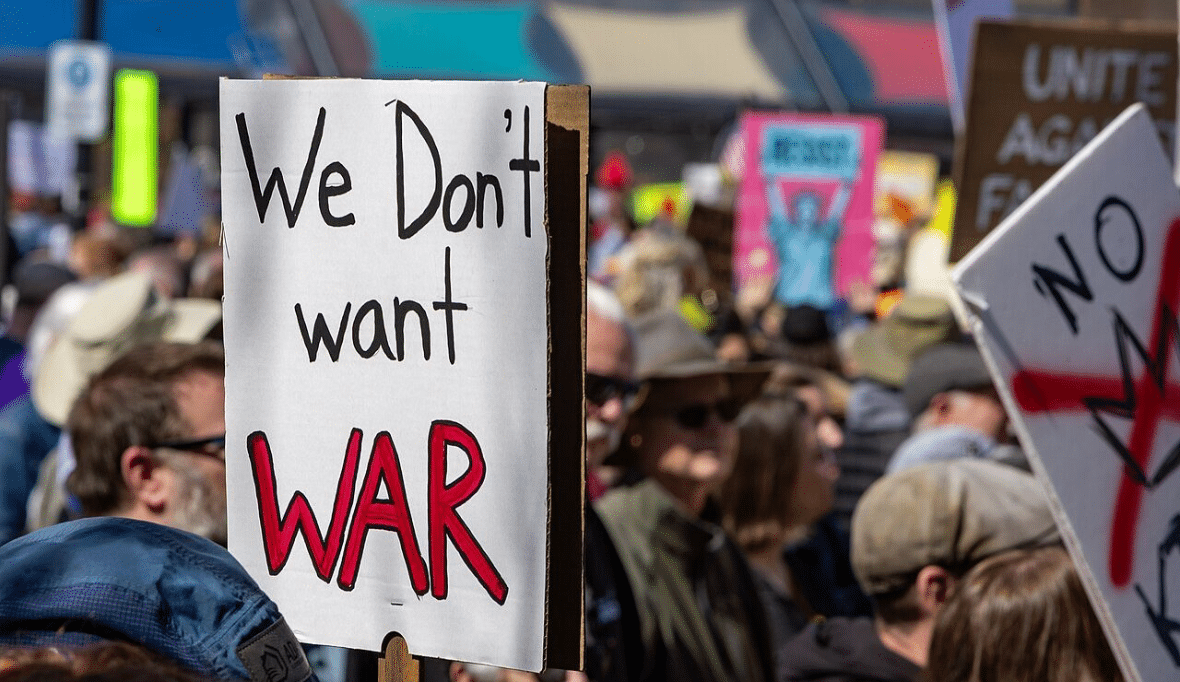
It is therefore even more urgent to build global resistance against war, militarism, and imperialism through mass demonstrations, blockades, and strikes.
Only if the working class’s potential strength is transformed into an organized force can a path to true peace be opened.
Behind the war and violence lies the ruling classes’ pursuit of power, prestige, and markets. The struggle for peace is therefore a struggle against the root causes of war—capitalism’s exploitation and oppression, and imperialism’s plunder.
The only way forward is to build the workers’ struggle and a socialist mass movement that can unite the oppressed in a common struggle for a socialist world of peace and freedom. Join the struggle for a socialist world free from all violence and oppression—join International Socialist Alternative, ISA.