With every tenth of a degree of additional warming, the probability of passing a tipping point increases.
Arne Johansson, Socialistiskt Alternativ (ISA in Sweden)
(This article was first published on 15 October 2025)
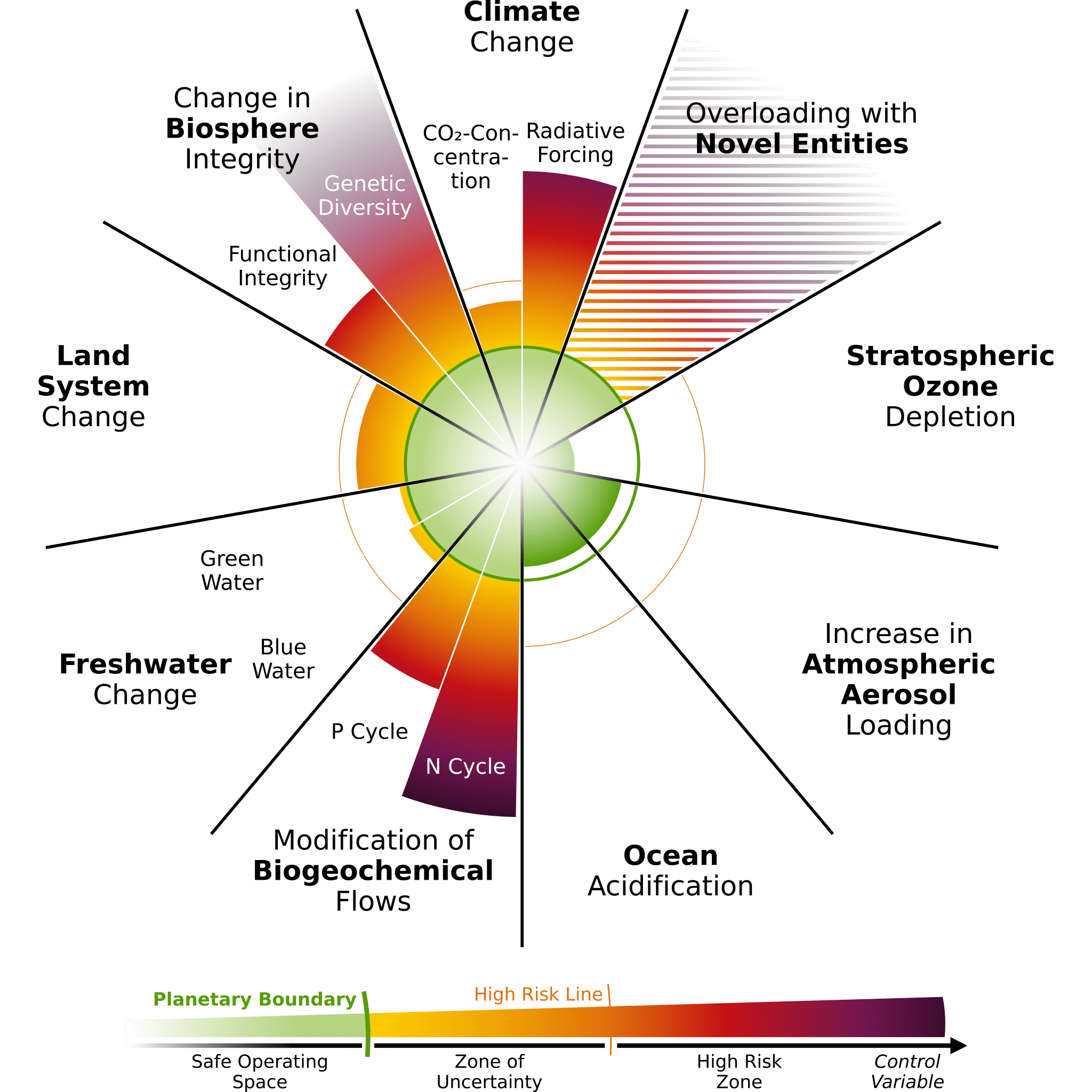
A major new review conducted by the scientific laboratory at Germany’s The Potsdam Institute for Climate Impact Research, in collaboration with researchers at the Stockholm Resilience Centre claims that ocean acidification has now exceeded critical thresholds for the Earth’s life-sustaining biosystems.
“Our planet’s vital signs are flashing red. For the first time, the Ocean Acidification boundary has tipped over— threatening coral reefs, fisheries, and the oxygen we breathe,” the report summarizes.
This means that seven of nine planetary boundaries have been exceeded. The six previous boundaries that, according to the world’s leading Earth system scientists, have been exceeded and continue to deteriorate are climate change, biodiversity, land use, freshwater, biogeochemical flows (nitrogen, phosphorus), and new synthetic substances.
Only the boundaries for the ozone layer and aerosol pollution (air particles) are still considered to be within the safe zone.
According to the review in the report Planetary Health Check 2025, ocean acidity has increased by 30-40 percent since pre-industrial times, pushing marine ecosystems beyond safe limits and impairing the oceans’ ability to function as the Earth’s stabilizer. Cold-water corals, tropical coral reefs, and Arctic marine life are particularly vulnerable as acidification spreads and intensifies. According to researchers, small sea snails, known as pteropods, which are an important food source for many species, are showing clear signs of shell damage due to more acidic ocean water.
“This intensifying acidification stems primarily from fossil fuel emissions, and together with ocean warming and deoxygenation affects everything from coastal fisheries to the open ocean. The consequences ripple outward impacting biodiversity, food security, global climate stability, and human wellbeing,” comments Albert Norström, researcher at Stockholm Resilience Centre and co-author of the report.
A new ninth report from the EU’s Copernicus Ocean State Report, published almost simultaneously, shows that the Baltic Sea is warming faster than almost any other sea in the world, second only to the Black Sea. Warming water causes more algal blooms, oxygen depletion, and deteriorating fishing conditions. It also causes heavier rainfall and storms leading to collapsed roads and railways as seen after the 2025 torrential rains in Västernorrland, a region in the north of Sweden.
“Very high sea surface temperatures also cause a lot of water to evaporate. This then rains down, causing problems with torrential rain over land,” says Professor Erik Kjellström, professor of climatology at the Swedish Meteorological and Hydrological Institute.
Ahead of November’s major climate summit in Brazil, COP30, the focus is on continuing climate change. No one can have failed to notice that the Paris Agreement’s 1.5-degree target was exceeded only nine years later in 2024. This has had dramatic consequences of heat waves, fires, torrential rains and powerful storms.
The World Meteorological Organization estimates that there is a 70 percent risk that 1.5°C will also be exceeded for the entire five-year period 2025-2029. According to forecast data from EarthChart, without a dramatic reduction in emissions, the world could reach a global increase of 2.5°C as early as 2050.
The latest study from the German Potsdam Institute, published in the journal Nature on October 1, presents observations showing how four major parts of the Earth system are on the verge of destabilization: the Greenland ice sheet, the Atlantic Meridional Overturning Circulation that drives the Gulf Stream, the Amazon rainforest, and the South American monsoon system.
The researchers’ main concern is how these networks of tipping elements interact with each other via the oceans and the atmosphere, which could trigger abrupt and irreversible changes with serious consequences.
The Greenland ice sheet is being destabilized by feedback loops that accelerate melting. The Gulf Stream is threatened by increasing freshwater inflows from melting ice and precipitation, which reduce the salinity and density of surface water—an important driver of circulation. At the same time, climate change and deforestation are weakening the Amazon rainforest, while the South American monsoon system risks abrupt changes in precipitation if the forest’s moisture recovery system is disrupted.
“With every tenth of a degree of additional warming, the probability of passing a tipping point increases,” emphasizes the report’s lead author Niklas Boers from the Potsdam Institute and the Technical University of Munich. “That alone should be a strong argument for rapid and decisive reductions in greenhouse gas emissions.”
Thus, the growing and, within the system, irreparable metabolic “rift” in the metabolism with nature, which, according to Karl Marx, already characterized capitalism in the 19th century, has grown into a chasm.
It is now clear that the fight for the climate, as well as for humanity’s threatened welfare, requires a global democratic and socialist uprising against the oppressive capitalist system, which, with its pursuit of profit, exploitation, plunder and war, is destroying the conditions for human life on the planet.