
March 4, 2026. Mika Wagner, SAV (ISA in Germany)
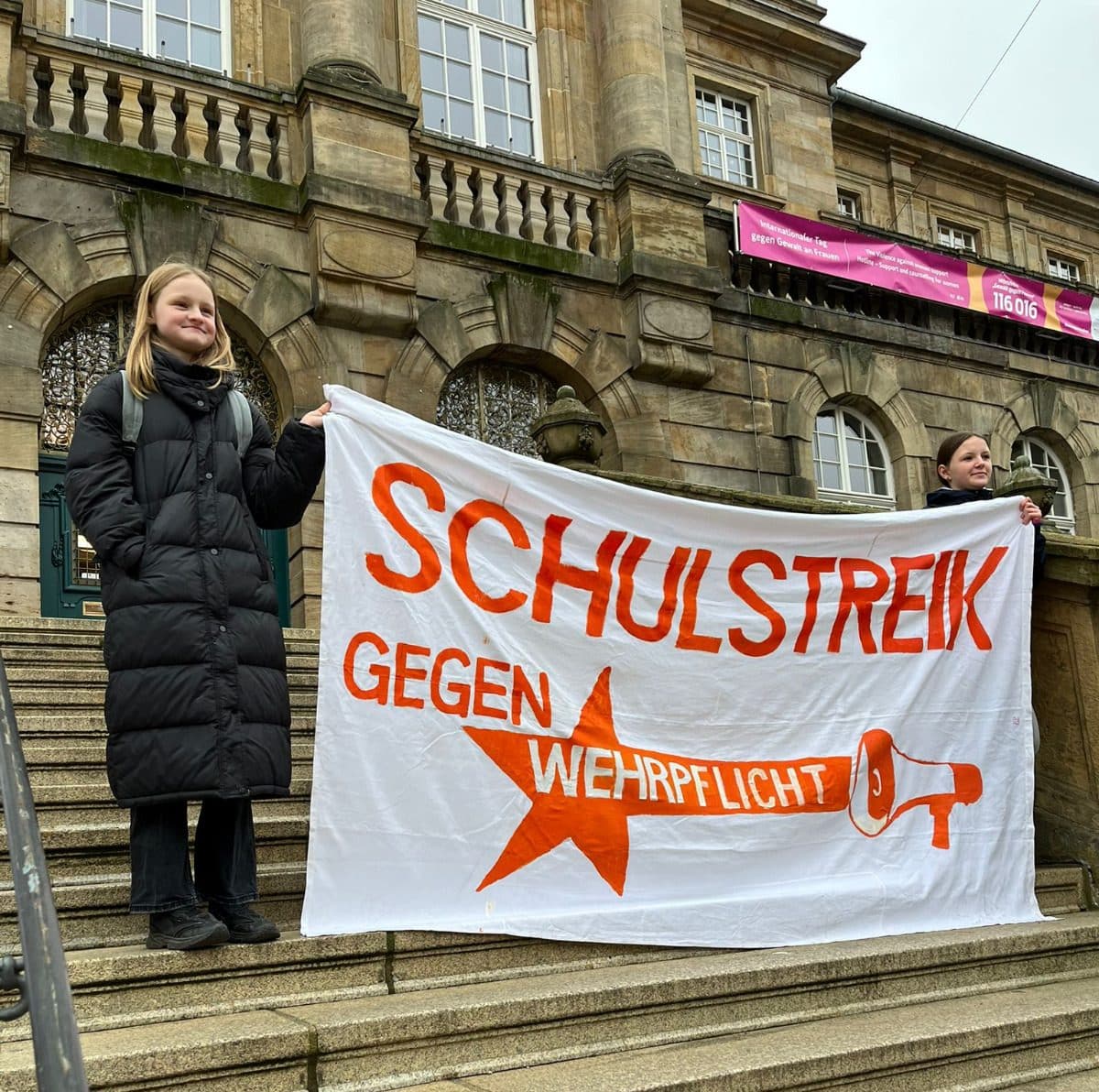
On December 5, 55,000 students went on strike against the new military service law. The next strike is planned for March 5. Committees against compulsory military service should be set up in all schools. The GEW education union should support the students with its own activities.
In an era of escalating imperialist conflicts over the redivision of the world, Germany is preparing itself for war—through the largest rearmament program in the history of the Federal Republic, the conversion of civilian infrastructure for military use, and the reinforcement of the Bundeswehr (German armed forces) with additional personnel.
We are also being mobilized ideologically—through war propaganda that tells us that “we” must rearm to defend “ourselves,” because otherwise Russian tanks will be in Berlin tomorrow. This ignores the fact that Russia is militarily and economically inferior to the EU—with a third of the European soldiers and significantly fewer tanks, aircraft, and ships.
What is really being defended against is not Germany’s borders, but Germany’s supremacy over Russia in Eastern Europe. The fight in Ukraine is not for freedom, democracy, and national self-determination, but for access to Ukrainian markets and raw materials—for whether Ukraine will be a dependent semi-colony of Russian or Western capital.
The expansion of the German armed forces and the steps toward conscription are intended to prepare Germany for this confrontation. A “strong Germany” is a Germany that has the military means to take offensive action in the Baltic States, the Baltic Sea, or Ukraine. The exact opposite of the propaganda claim that armament secures peace is true: armament and conscription dramatically increase the risk of war.
Building a Movement Against Conscription and War
The school strikes on December 5 were a good start. Around 55,000 students took to the streets in over 90 cities. They went beyond merely criticizing conscription as a coercive measure by the state. With slogans such as “The rich want war, young people want a future,” they opposed preparations for war and made it clear in whose interests armament is taking place. A considerable proportion of young people are not fooled by militaristic propaganda and are prepared to fight for a future worth living, without war and exploitation.
Regular anti-militarist school strikes modeled on Fridays For Future can be a means of building a movement. However, it would be a mistake to simply imitate Fridays For Future without learning from the movement’s mistakes. Because the aim was to get as many people as possible onto the streets at any cost, political radicalism was shied away from. The movement stopped posing a threat to those in power and thus weakened itself.
Our movement must not shy away from naming the systemic causes of the new military service law. It must not limit itself to mere criticism of conscription and must not remain silent on the issue of rearmament.
Before the conscription law is officially implemented, the federal government is focusing on “economic conscription.” With a gross monthly salary of €2,600 for conscripts and other financial incentives for longer-term commitments, the aim is to lure young people to join the armed forces. Faced with a deteriorating economic situation, military service is intended to be an attractive alternative to poverty, grueling low-wage jobs, or harassment by the job center for young people with no prospects. This is the cynical content of Pistorius’ “principle of voluntary participation.”
The movement against conscription should emphasize that this is only one part of Germany’s preparations for imperialist wars in the interests of the rich. If we want to consistently oppose conscription, this means that we must oppose capitalism, the German state, and the Bundeswehr (German armed forces), regardless of whether the latter is made up of conscripts or “volunteers” who have no other economic prospects.
Getting Started Right Away
The school strikes will be the main focus of our mobilization efforts. However, continuous activity is necessary. According to the Bundeswehr, the links to the questionnaires will be sent out starting in the second half of January. How to deal with this must be discussed. Those affected should not have to tackle this individually; an organized, collective response is necessary. Committees against conscription should be set up in all schools, where students can exchange ideas, learn about political issues, prepare actions, and develop joint strategies for dealing with questionnaires and medical examinations, as well as repression against students who are anti-militarist.
The Left Party has decided to provide resources for advising people against military service. This is a good step. It is important that the Left Party does not limit itself to individual counseling, but uses this as a means to build the movement. It should use its financial, human, and organizational resources to prepare for the strikes. It can support students in setting up committees by providing advice and, if necessary, meeting rooms. It must mobilize its members for demonstrations, strikes, and committees and bring the issue to the public’s attention with its own demonstrations. At the “All Eyes On Gaza” demonstration in Berlin in September 2025, the party played a central role in mobilizing over 100,000 participants and showed what it is capable of. It can and must play a similar role in organizing the youth movement against conscription.
The German Education Union (GEW) should mobilize its members to support the students. On March 5, teachers should participate in the strike demonstrations with GEW banners and flags. Students also need support from their teachers in everyday school life, e.g., in countering Bundeswehr advertising.
The SDS and other left-wing university groups should consider organizing strikes at universities on March 5. The protest against conscription should be linked to demands for funding for schools and universities and against cuts in education.
Military Service Modernization Act: What Can We Expect?
The Military Service Modernization Act, passed by the Bundestag on December 5, 2025, went into effect on January 1, 2026. In 2026, people born in 2008 will be the first to fill out online questionnaires. This is voluntary for women but mandatory for men, who could face a fine if they don’t do it. Among other things, the questionnaires ask about willingness to perform military service and physical fitness. Those who agree to perform 6 to 23 months of military service will be drafted as early as 2026.
By July 2027, 24 draft centers are to be set up so that entire age groups can be drafted. By 2035, the government aims to recruit 75,000-90,000 new active soldiers and 200,000 new reservists. If not enough volunteers can be found, a so-called “conscription based on need” will fill the gap.
By emphasizing “voluntary” participation, the federal government wants to obscure what this law really is: the first step toward reintroducing compulsory military service. Questionnaires and physical examinations will be used to collect the necessary data for this purpose. At the same time, the Bundeswehr is expanding its capacity to recruit and train an entire generation.