Zhu Gong, chinaworker.info
2026 marks the opening year of China’s 15th Five-Year Plan (2026–2030). During the ‘Two Sessions’ (parallel NPC and CCPPC rubber-stamp meetings) in March, the 15th Five-Year Plan was formally ‘passed’. The CCP (so-called ‘communist’) dictatorship proposed boosting domestic demand, a promise it has repeated for more than two decades, and vigorously developing high-tech industries, while lowering the 2026 GDP growth target to 4.5%–5%.
Regarding the past year, the regime claimed that 2025 “met the 5% target,” just as it did for 2024 – a clumsy lie. But this year’s downward adjustment itself demonstrates that the CCP has finally realized with frustration that its endless systematic propaganda has backfired: fewer and fewer ordinary people, economists, and – crucially – the bourgeoisie themselves, are willing to continue believing the CCP’s economic myths!
The CCP’s official GDP growth target has been set at its lowest level since 1991, while the fiscal deficit remains at a historically high 4 percent. It has adjusted the fake number slightly to give an appearance of statistical credibility. In our view, the CCP’s policy is equivalent to repeatedly injecting adrenaline into a critically ill patient just to maintain vital signs.
Officials at the Two Sessions press conferences claimed that the Chinese economy is “on a long-term upward trend,” but no one with a clear head would believe such nonsense. In 2025, Guangdong Province, which has ranked first in the country in GDP for 39 consecutive years, saw GDP growth of only 3.9 percent, according to official data. If even the most developed region is like this, where does the national goal of “maintaining 5 percent growth” come from?
The CCP’s long-standing manipulation of statistical data renders its figures inherently unreliable. How can an economy that is supposedly growing by 5 percent annually have a 40% youth unemployment rate (although the official manipulated data claims only 17%)? Would millions of migrant workers be abandoning their lives in cities and wealthy provinces to return to their hometowns if the economy was really hitting 5 percent growth? Would thousands of factories and construction projects be shutting down as is the case in 2026?
Other indicators also reveal the plight of the Chinese economy. The continued decline in the national Producer Price Index (PPI) indicates significant overproduction (oversupply), forcing companies to engage in relentless price wars to sell their products, resulting in persistent deflationary pressures. Since October 2022, the PPI (a measure of ‘factory gate prices’) has fallen for 41 consecutive months.
While the PPI rebounded with a 0.5% increase in March 2026, reversing the previous month’s 0.9% decline and being interpreted by the CCP media as an economic “recovery”, this was primarily driven by the Iran war, which pushed up energy and raw material prices, concentrated in sectors such as metal smelting and oil and gas extraction. Apart from the AI industry chain, price increases in most sectors are largely due to companies facing cost pressures, and do not signify a substantive recovery in overall demand.
‘Japanification’
This also indicates that the Chinese economy is exhibiting classic characteristics of ‘Japanification’: prolonged deflation, overcapacity, and declining returns on investment. However, because China’s economy is far more dependent on real estate, local government debt, and exports, its crisis is even more severe than Japan’s was. As Mao Zhenhua, a professor at the University of Hong Kong, remarked: “Apart from high-tech and export sectors, the Chinese economy is very cold.”
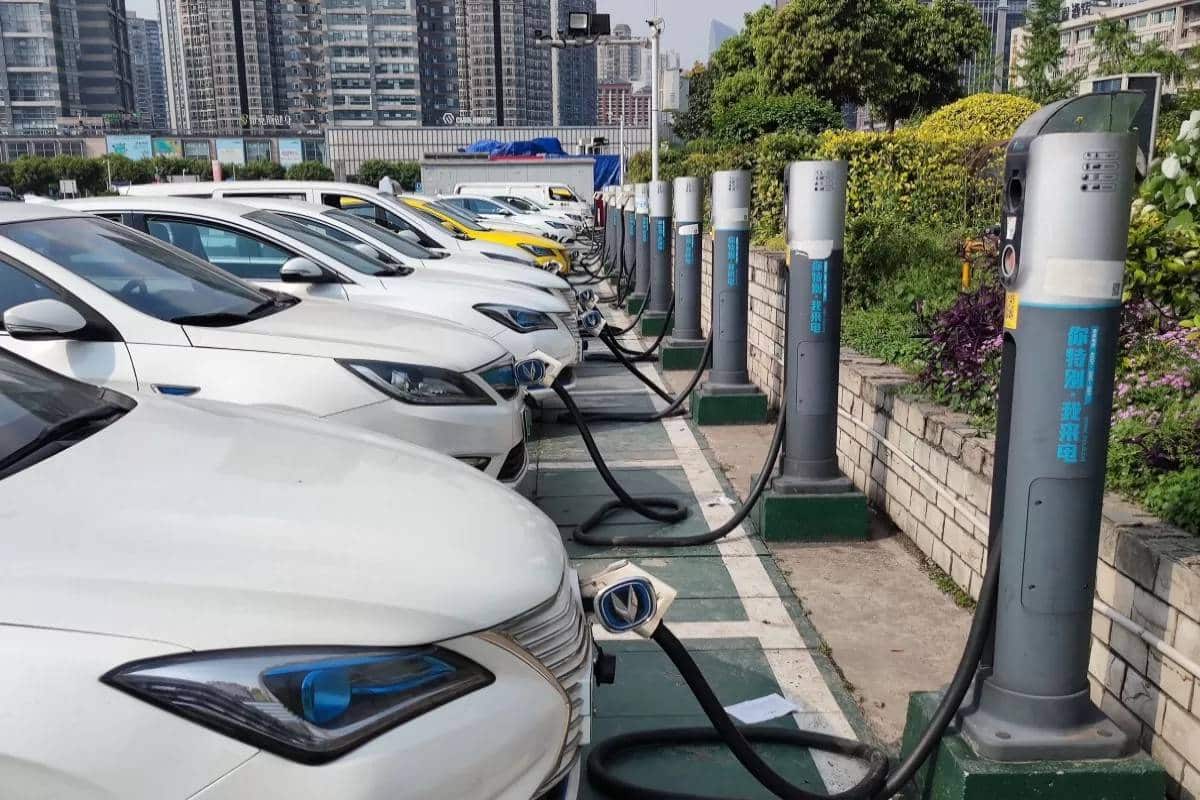
The much-publicized development of AI, semiconductors, and other “future industries” essentially reflects the CCP’s realisation that the global economy in 2025 was being propped up largely by AI-related investment, leading it to make a gambler-style “all-in” bet. This is merely a sequel to the so-called “new productive forces” such as electric vehicles, solar panels, and lithium batteries, all of which are already deeply trapped in crises of overproduction.
The CCP exaggerates its overall successes in these fields. Direct-to-consumer platform Shein accounted for a bigger share of total Chinese exports in 2025 (85 billion USD) than electric and hybrid vehicles (57 billion USD). This shows how ‘old’ industries like textiles still dominate over the over-hyped ‘new’ industries.
Under capitalism, AI may ultimately prove to be “much thunder, little rain,” with enormous sums of investment wasted on projects incapable of large-scale commercialization, eventually generating new bubbles and new forms of overcapacity in the future. Just as real estate and infrastructure were once regarded as the “engines” of China’s economic growth, only to ultimately evolve into sources of debt traps and deflationary crisis.
So-called “embodied intelligence,” especially the humanoid robots favored by the CCP in its propaganda, does not automatically replace labour under capitalist logic – this is not a new topic. Marx already explained in Capital that “the purpose of machinery under capitalism is not to lighten labour, but to produce surplus value.” In labour-intensive industries (such as textiles), where a large unemployed workforce creates a large pool of cheap labor, capitalists tend to prefer lower wages rather than full automation. In sectors with widespread automation (such as the photovoltaic industry), unemployment will further increase, and capitalists will use this to lower wages and weaken workers’ bargaining power. This however will further drag down China’s already weak consumption – robots don’t shop!
Low consumption
The Consumer Price Index (CPI), which reflects actual inflation experienced in daily life, also demonstrates weak demand. Over the past two or three years, China’s CPI has repeatedly approached zero or even turned negative, while the government nevertheless set a 2 percent inflation target for 2026 (the same target was set for 2025, but the annual increase was only 0.7 percent). In March 2026, CPI rose 1.0 percent year-on-year while falling 0.7 percent month-on-month, reflecting the fading of the post-Lunar New Year consumption bump.
Core CPI, excluding food and energy, rose 1.1 percent in March; even if this were the true figure, it would still be insufficient to indicate a significant recovery in consumption. Overall demand remains extremely weak.
Behind weak consumption lies a deeper crisis in people’s lives. Given that Xi’s government has already revised its unemployment statistics methodology, no one can accurately determine the real unemployment situation. However, youth unemployment remaining above 20%, even as high as 40%, has almost become an open secret.
Faced with employment difficulties and increasingly bottomless exploitation in the workplace, many young people have chosen “45-degree lying flat,” or simply returned to their hometowns to “live off their parents,” relying on family support to reduce living costs. Given the unstable jobs market, persistently pessimistic income expectations, and the backdrop of Sino-US imperialist conflict, the CCP’s attempt to shift the Chinese economy from export-dependent to “boosting domestic demand” is even more unrealistic than it was twenty years ago when Wen Jiabao made similar promises in a Chinese economy that was then growing at 10% annually.
Deflation trap
Deflation itself is characterized by a vicious cycle. According to the Wall Street Journal, Xi Jinping once asked, “What’s wrong with deflation? Don’t people like lower prices?” However, under capitalism, falling prices do not improve people’s lives; they increase the real value of existing debt.
Deflation also means further shrinking corporate profits. To maintain profits, companies will shift the crisis to workers through layoffs, salary cuts, and “cost reduction and efficiency improvement,” leading to increased unemployment, decreased income, further eroding the spending power of the masses, and intensifying downward price pressure.
The Xi government clearly believes it can suppress this crisis cycle through authoritarian state interventions and administrative power, but once this deflationary spiral forms, it is extremely difficult to reverse through economic policy.
This also reflects that contemporary capitalism, not only in China, is falling into an increasingly deep crisis of long-term economic stagnation, increasingly relying on protectionism and even war (the threat of war to humanity is growing!) to divert attention from such contradictions.
How to get out of the crisis?
Therefore, the fiscal policies and rehashed ‘future industry’ upgrading proposed in the 15th Five-Year Plan are not a way out of the crisis. These policies are a desperate act of misdirection by the Xi regime to show “solutions” while hiding the full scale of the economic crash. It is an attempt to delay the full eruption of the crisis while being incapable of reversing the zombification of the Chinese economy. China’s economy is already deeply trapped in a vicious cycle of overproduction, debt growth, and insufficient demand. The so-called ‘future industries’ and industrial upgrading policies are not only incapable of saving the Chinese economy, but may instead become the fuse for the next and even greater crisis.
Only when the working class overcomes its current debilitating state of disorganisation and atomisation, and succeeds in building a strong class struggle organization will there be a way out of the crisis. This requires the working class to seize political and economic power and on the basis of a democratic planned economy, to ensure that production truly serves the needs of the people’s lives and protects the environment, workers’ health, and their right to rest.
Only then can we break free from the constraints of capitalist profit logic, confiscate the property of the capitalist groups, and ensure that new advanced production tools and social wealth are no longer used for the profit-seeking of a few, but for the common well-being of the vast majority. Only then can we solve the crisis of capitalism, which may also be the last existential crisis in human history, once and for all.