August 4, 2026 Connor Rosoman, Socialist Alternative (ISA in England, Wales & Scotland)
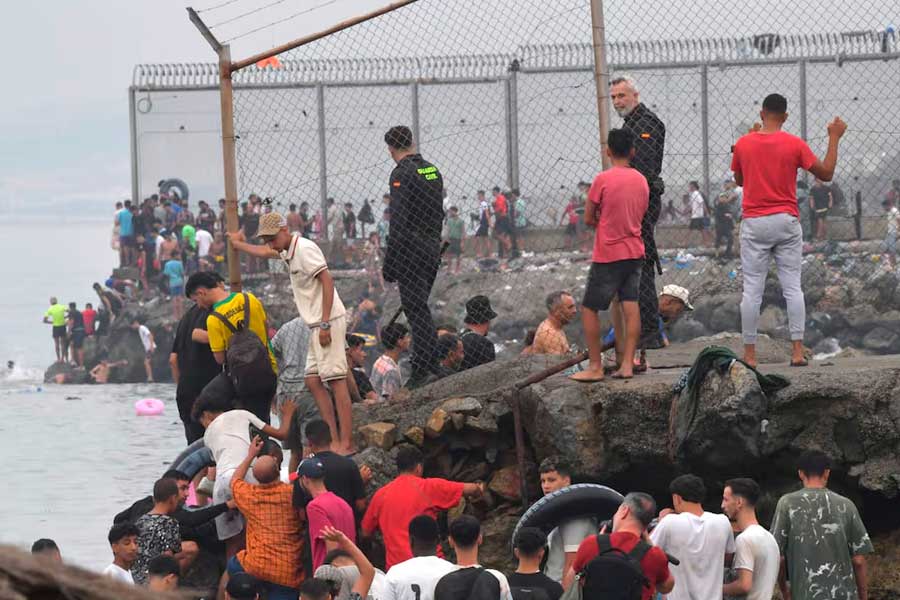
At the end of July, 60,000 migrants entered Ceuta – a city with a population of around 80,000. Ceuta is one of two enclaves on the African continent maintained by the Spanish state – a direct leftover from its centuries-long colonial rule over Morocco.
At least 88 women, men and children perished while attempting to cross the heavily fortified border. Within 48 hours, the vast majority of those who had arrived in Ceuta had been returned to Morocco following a major mobilisation of the Spanish military.
The right wing in the Spanish state and throughout Europe have not hesitated to whip up a frenzy against the migrants. Increasingly familiar tropes were rattled out, calling the incident an ‘invasion’ of ‘fighting-age men’ against Europe etc. But rather than an invasion, this tragic incident is a symptom of the deep crises in the world today.
European powers are scrambling to use this episode as a pretext to harden the external and internal borders of the EU and ramp up their anti-migrant agenda. Trump’s regime in the US has used the incident to strengthen its own hand in Europe and pressure European capitalist leaders into following his lead on anti-migrant policies. Meanwhile, footage circulates online of migrants being attacked in the streets of Ceuta as the far right organises racist pogroms throughout the city, which in turn have been met with impressive resistance by local Ceuta residents.
Roots of the Crisis
Amid this festival of racism and reaction, there is shockingly little space being given to discussing the human beings at the centre of this crisis and its causes. Why did 60,000 people make the desperate journey to Ceuta in the first place, risking their lives in the process? To the right wing and capitalist press, these people are treated as a force of nature or a pack of animals rather than real people with aspirations, interests or agency of their own.
The latest wave of crossings seems to have been triggered in part by news of the Spanish supreme court ruling that people intercepted at sea trying to cross into Ceuta or Melilla (the Spanish State’s other exclave on the African mainland) could not be “summarily returned”. Misleading social media posts went viral in Morocco, suggesting that this would lead to an immigration free for all. This ruling was, in fact, a minor technicality rather than any meaningful change to Spain’s draconian racist border regime. This is, after all, one of the world’s most dangerous borders, lined with razor wire which has been known to slice arteries upon contact with human flesh.
The reality is that millions of working-class and poor people in Morocco and across the African continent remain trapped in miserable conditions under this system. Most of those who made the crossing were Moroccans, but many others were reportedly from sub-saharan Africa including Sudan, where genocide and war have destroyed countless lives.
Capitalism and imperialism are wreaking havoc upon the continent, and many people see no choice but to try to escape and seek a better life. The Spanish economy stands at 10x the size of that of Morocco where the average annual salary is around €6,400, less than half of even the minimum wage in Spain. The fundamental cause of this deep structural inequality is the history of colonial and imperialist oppression of Africa, which since the formal independence of most countries has been perpetuated by neocolonial domination. This is also the source of the wars and climate disasters which drive repeated waves of migration. For as long as this system persists, no racist migration laws, no matter how brutal, can prevent waves of migration. The capitalist class likes to draw a line between ‘genuine’ refugees and economic migrants – but this line is largely artificial.
Today, precisely when the crises of the system are intensifying every one of these issues, capitalist governments in Europe and elsewhere have turned toward increasingly hostile policies to attack migrants. This allows them to divide workers in their ‘own’ countries and maintain support for their system, while importing migrant labour in precarious conditions allows the bosses to exploit them more easily. Morocco, for its part, plays the willing role of a prison guard for the European ruling classes, who send funds to its dictator King Mohammed VI in order to maintain a heavily militarised border.
Political Maneuvers
In this case, it is likely that the Moroccan state at least facilitated the mass crossing into Ceuta. In 2021, 10,000 people entered Ceuta in a similar incident. In the days prior, Spain had treated the leader of the Polisario Front – a pro-independence group in the Moroccan-controlled Western Sahara region – at a hospital in Logroño. Morocco responded by dropping border controls and allowing an influx of migrants into Ceuta. In 2022, the Spanish state renounced its support for pro-independence forces in the region and re-established diplomatic relations with Morocco – but not before using state forces to kick out thousands of migrants.
This episode is reminiscent of the ‘weaponised migration’ tactics taken up by the Lukashenko regime in Belarusor Erdogan in Turkey against their EU neighbours. By exploiting desperate refugees, they fan the flames of the far right and stoke political tensions in order to extract concessions from EU member states.
In the last period, tensions have grown between the two governments. The government of PSOE’s Pedro Sanchez has made efforts to show off its ‘progressive’ credentials, with outspoken opposition to the genocide in Gaza and its refusal to let US military forces use their Spanish bases for attacks on Iran. On the other hand, Morocco has strengthened ties with Trump’s regime in the US and Israeli state in recent years, including signing onto the Abraham accords in 2020. While no direct role of either the US or Israeli regimes in the current situation has been confirmed, neither Trump nor Netanyahu have hesitated in using the crisis as a stick with which to beat the Spanish government and reassert their position against the ‘woke’ left.
Within the Spanish state, the far-right Vox party has made gains in recent years on the back of a cost of living crisis, persistent unemployment (which currently stands at 9.87%) and housing crises by scapegoating immigrants for their own political gain. It has been followed in this regard by the traditional right-wing Partido Popular.
While not fundamentally challenging the state’s racist border regime, Sanchez has presented a more progressive facade, with the government bringing forward plans earlier this year for the regularisation of almost half a million undocumented workers, allowing them to live and work legally in the Spanish state. Next year’s general election will undoubtedly be a factor on the mind of Sanchez as well as his political opponents in their responses to this crisis.
Sanchez’s response has given ground to the toxic ideas of the right, describing the situation in Ceuta as a “violation of territorial integrity” (barely distinguishable from the use of the term ‘invasion’ by the right). He then sent in the military to throw out more than 50,000 people and restore control on the streets. What’s more, a new 500m border wall is being constructed – even dissecting waterways – to keep people out. The supreme court decision of just days ago has not made any difference.
In reality, Sanchez is repeating the pattern seen across the world, of centre-left governments aping the ideas of the right. However, this only fuels these forces further. After all, if anti-migrant policies are put forward by all wings of the establishment, why would people support only the most watered-down version of them?
Solidarity Not Division
The reassertion of ‘fortress Europe’ is no solution. Over the past decade, the Mediterranean has been converted into a mass grave. This year has already been one of the deadliest for refugees making the crossing into Europe, with over 1,000 people losing their lives fleeing poverty, war and famine since the start of 2026.
On top of this, we are in a new era of imperialist war, with the highest number of active conflicts worldwide since WWII. This is, in turn, sharpening the permanent cost of living crisis across the neocolonial world, making life unbearable for huge swathes of the population. Meanwhile, the climate crisis acts as a multiplier for all the other crises in the world today.
The response of the ruling classes across the board has been to double down on nationalism and authoritarianism. Right wing leaders are scaling up racist anti-migrant policies, with Italy’s Georgia Meloni calling for ‘relocation hubs’ across Africa for those deported from Europe. But the truth is that these politicians have nothing on offer to address the issues facing working-class people, nor the factors driving this crisis. In fact, they are at the forefront of preparing more wars, and rolling back climate legislation – all while defending the grinding down of workers’ living conditions.
The only solution lies in building an international movement of the multi-racial working class that stands in solidarity with the victims of these crises and points the finger at the real culprit – the capitalist system that breeds crisis and poverty for billions of people worldwide.
A positive example has been set by hundreds of workers and youth in Ceuta, who shut down a rally by Núcleo Nacional – a neo-nazi organisation who travelled there to stir up racial hatred. The fascists were forced to call off their demonstration in the face of this community opposition. We need to organise similar mobilisations against the far right wherever they rear their heads. We need working-class and community resistance against any attempts to attack or intimidate migrant communities, as well as against the racist policies of the state itself. In Morocco and elsewhere on the African continent, working-class and oppressed people must organise to overthrow their capitalist rulers and take democratic control of the wealth and resources, in order to build a dignified future at home for workers and young people.
The so-called ‘migrant crisis’ in Europe is a crisis of capitalism’s own making. The reality is that countries in Europe and elsewhere are more than capable of providing a decent life for current citizens and migrants alike. In the Spanish state itself, there are up to 4 million empty homes that could be taken into public ownership to provide housing for all. While the bosses stoke fears about migrants taking jobs, the real reason for unemployment is that capitalists won’t employ people unless they can make a profit. Socialists fight to share out the work, to reduce the working week with no loss of pay, while fighting for decent wages and a union for all workers.
At the same time, a programme of green jobs to tackle the climate crisis would create thousands of new jobs, while also combatting one of the most important factors forcing people to flee their homes across the neocolonial world. This should be coupled with a struggle against the other major factor driving mass displacements right now: war and imperialism – including fighting for an end to NATO, which serves as a military alliance to enforce US and European imperialist interests.
The fight to defend migrants and address the causes of mass migration is inherently an international one. Last year, thousands took to the streets of Morocco as part of the international wave of Gen Z revolts, calling for better healthcare, education and employment opportunities. These movements showed the huge energy of youth across the neocolonial world – but also the need for a revolutionary party that can translate that energy into a strategy and a programme to throw off capitalism and imperialism. The failure to do so has brought catastrophic consequences in Sudan, where the civil war represents a bloody reprisal against the mass movement of 2019. A new wave of struggle, building on the lessons of these movements, is needed in order to win a genuine future for young people. That’s why International Socialist Alternative is organised across borders to support the building of such a struggle, as part of the fight for a socialist world.