October 5, 2026
Per-Ake Westerlund, ISA International Political Committee
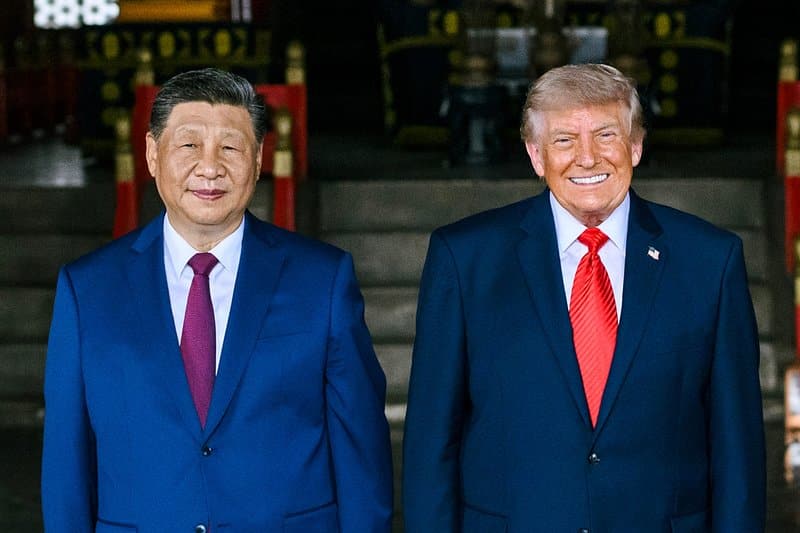
Xi Jinping’s 3-day state visit to Washington was an inferior, even emptier re-run of Trump’s visit to Beijing in May. Two imperialist superpower tyrants met and avoided everything important. Wars, climate catastrophe and AI were set aside for salutes, dinners and pandas. It was a “nothing burger”, Edgard D. Kagan at CSIS commented.
The event says a lot about world developments today. For both sides, it was about hiding crises that have deepened further since May, pretending everything is under control, and winning time in order to prepare for inevitable and sharper confrontations. The two presidents underlined each other’s “greatness” for their domestic audiences, including their opposition.
The only real agreement was to meet twice more this year (at the APEC summit in Shenzhen and G20 in Miami). This unique pace of meetings underlines both the fragile world situation and the continuing need of both “strong men” to promote each other’s importance. So too does the unique red carpet welcome Xi received from Trump. Reports say the actual talks between the two only lasted 90 minutes of the three day visit.
The meeting offered no “common global leadership”. Under the surface of incredible and hypocritical flattery, talk about friendship and peace, there is a continued aggressive imperialist build-up. As the Economist commented, “the main mission of American and Chinese commanders is to prepare to fight and win a conflict with one another, most probably over Taiwan”.
New Sanctions Since May
Since May, almost nothing has happened regarding the agreements which they claimed to have made at their previous face-to-face summit in Beijing.In fact since May, both regimes have taken new measures against each other – for example new blacklistings and restrictions against companies with military links. Trump is frustrated that Chinese exports of rare earths are only two thirds of what was agreed. Beijing protested when Washington threatened sanctions against countries trading with Iran this summer, of which China is by far the most important. The US also has ongoing investigations that can lead to new sanctions. Both sides are investing heavily in AI, the main ongoing arms and technological race between them.
None of these issues were dealt with during Xi’s visit. What was officially reported – as in May in two separate statements with differing content – was mostly a repeat of the talks in May. The ‘Board of Investment’ and the ‘Board of Trade’ launched in May have yet to do anything.
In May, Trump agreed to lift tariffs on $30 billion worth of “non-sensitive” Chinese exports. This was now repeated, but classified as “favourable treatment” rather than non-tariffs. This time it mentions trade in both directions so the value is raised to $60 billion. It includes 1,619 US items, featuring agricultural products “as well as whales and dolphins for breeding”. 77 non-sensitive Chinese items are listed, including clay pigeons for shooting (Financial Times 29 September).
China’s purchase of 200 Boeing planes has still not progressed, or been increased as Trump predicted, but imports of US soybeans have been fulfilled. Another repeat was the Thucydides Trap theme which was raised once more by Xi, to underline his thesis of China as a rising power, one of two great powers.
The two sides’ statements from the meeting are selective and contradictory. Iran, despite being Trump’s largest crisis, was not high on the agenda, due to low expectations. The statements only repeated that Iran should not develop nuclear arms, which is Tehran’s official position, and a general stance against tolls on seafare.
One report says that “Unlike the White House fact sheet issued after that meeting [in May], this latest one does not reaffirm a shared call to reopen the Strait of Hormuz. More notably, there is no mention of possible reductions in Chinese purchases of Iranian crude or promises to stop providing Iranian companies with geospatial data and satellite imagery, both of which the Islamic Revolutionary Guard Corps is reportedly using to attack commercial and military shipping in the Strait of Hormuz and to launch precision strikes on US military bases in the Middle East “
The US has also backed off from its previous threats to severely sanction countries trading with Iran, which would target China first and foremost. It is of course also in the interest of the CCP regime to calm the energy crisis, as was also shown in its recent statement against the threat of closure of the Bab al-Mandeb Strait. Iran is an ally of China, but Beijing’s relations with the US are more important. Xi Jinping was welcomed with a red carpet, while the same B2-bombers used against Iran paid tribute in the sky above.
Washington claims that Trump raised the need to increase China’s exports of rare earths, but Beijing’s statement does not mention rare earths at all. In turn, Beijing’s account states that Xi raised Taiwan, arguing Trump should oppose independence, but the White House readout does not mention Taiwan. The Financial Times reported another “area where the two statements diverged, China said the US and Chinese militaries had agreed to ‘conclude a memorandum of understanding on crisis communication’. The Trump administration said that was not true”.
“Truce” Prolonged
On trade, the fragile truce established in South Korea in November last year was prolonged to 10 January – a very short extension. Beijing has pushed for it to last the entire period of Trump’s presidency. The US, however, wants to keep all options open, including new tariffs and sanctions.
In May, the Peterson Institute for International Economics (PIIE) estimated the US’s average tariff on Chinese goods at 51.1 percent, covering all imports. In comparison, China’s average tariff on American goods was 32.6 percent. With the Supreme Court ruling to end some tariffs coming into force in July, China’s effective tariff rate, still the highest of all countries, was lowered to 22.8 percent, according to the University of Pennsylvania.
What the US seems to have won this time is coal exports to China of 10 million metric tons per year in 2027 and 2028, underlining the two powers’ common fear of energy crisis and neglect of the environmental consequences. China already produces 51 percent of the world’s coal. A vague “working group to discuss agricultural trade” was also to be established.
Again, Trump brought in tech billionaires such as Jeff Bezos (Amazon), OpenAI’s Sam Altman, Elon Musk (SpaceX) and Jensen Huang (Nvidia). Xi, however, brought no Chinese CEOs to the event. Chinese CEOs would (correctly) not expect to achieve any deals in the US – with Alibaba, for example, on the US sanctions list – and in any case they would not have played any helpful role as decorations as the US CEOs do for Trump.
On AI, as expected nothing was reached apart from setting up a “dialogue” between the two powers. Trump, however, claimed that Xi accepted his latest renaming, to say “superintelligence” instead of AI. There is no such mention in the Chinese statements.
Taiwan
Chinese media, controlled by the CCP, underlined how Xi emphasised Taiwan as the main danger in their relations, pushing for Trump to replace the ambiguous position of “not supporting” Taiwan independence with “opposing” independence. This is another rerun of May. Trump, however, only said that they did not discuss it much, and that Xi knows his position. In the end, “Taiwan was not featured in either side’s end-of-summit readouts”.
However, what will worry governments in Taiwan, and Japan, is the report that “David Perdue, the US envoy to Beijing, said Trump has also asked Xi whether China was interested in buying US weapons. It was not clear when the comments were made, but they have drawn criticism in the US given China is viewed as its biggest military rival” (Financial Times).
Both Trump and Xi raised their states’ cooperation in WW2, with Chinese reports stressing the war was against Japan. The relationship between Beijing and Tokyo has been at a new low since right-wing nationalist Sanae Takaichi became prime minister and said a war over Taiwan would be existential for Japan. This clash has had big effects on trade and economy as well as leading to increased military exercises.
Is the US an unreliable partner? Japan will increase its already rapid expansion of its military, and try to decrease its dependence on Chinese goods. There is similar unease in India on trade and tariffs.
The Taiwanese government is still waiting for a decision on the $14 billion purchase of arms that has been on hold since May. There is also increased fear in Taipei over Trump’s seeming infatuation with Xi. However, US imperialism can’t give up its power and influence in Taiwan and the region. The new arms sale – the biggest on record – is paused, but not stopped. Overall Trump has authorised 50% more weapons to Taiwan than any other president since the 1979 Taiwan Relations Act, which legally requires the US to provide “defensive” weapons to the island. In the meantime, Taiwan will continue its own increase of military spending boom. The Taiwanese economy is reaching record growth, over 11%, based overwhelmingly on TSMC’s global monopoly in producing advanced chips for AI and tech companies. 100 percent of Nvidia’s AI chips are made in Taiwan.
In the US, Trump has been criticised by Democratic China hawks, urging the arms sale to be fulfilled.
Trump’s Crisis is a Crisis of US Imperialism
Trump’s switch from claiming China was “raping” the US economy to praising his “great friendship” with Xi Jinping is based on crises developing for US imperialism, in many cases caused by his own actions. The war on Iran has led to a collapse in US credibility globally, not least in the Middle East. It has caused an energy crisis, raised inflation and debts, and with it interest rates globally. In addition, a very large share of US arms have been used up, which will take a long time to recover from. The war aims are lost, causing discontent against Trump, including among former supporters. This will have an effect in the coming midterms elections which most likely will go against Trump and the Republicans.
However, the Trump regime is still a Bonapartist regime, based on the president using the state in a more open, aggressive, way with little regard for democratic niceties. The military expansion will continue, alongside the use of his private racist ICE forces and other repression. Threats of tariffs and military action are still on the agenda, particularly in Latin America. This is the regime the world’s dominant imperialist power still relies on.
The Crisis in China
Xi Jinping’s regime is also in several simultaneous deep crises, something often hidden or not understood, even in some sectors of the left internationally, due to the dictatorship’s almost total monopoly on information. The economy, the cornerstone of the CCP dictatorship’s claims of success, is in deep crisis. The investment engine is no longer moving ahead. “Fixed asset investment declined 7.2 per cent over the first eight months of the year from a year earlier, deepening from a fall of 6.7 per cent in the year to July” and “official growth Second-quarter was reported at 4.3 per cent, one of its lowest readings in decades” (Financial Times)
In reality, economic growth is close to zero and the inflated official figures are increasingly absurd. The social consequences are huge. This summer Li Daokui, director of the Center for China in the World Economy at Tsinghua University’s School of Economics and Management, a former top advisor to the regime and central bank, reported unemployment standing at 48 million. The Swedish daily Dagens Nyheter reported “For 40 years, people have been migrating from rural China to the major cities at a rate of 15 million people a year on average. [This process ending] has created a sense of unease amongst broad sections of the population, particularly amongst workers. (…) Today’s China is full of people who used to earn around [7,500 yuan], but who now have to make do with half that amount.”
In the past few years, a powerful trend of reverse migration – from cities back to rural areas – has been seen. According to the Financial Times, “As of 2025, more than 53 million people work as food delivery or ridesharing drivers in China, up 10 million in two years, estimates the China New Employment Forms Research Center, a think-tank affiliated with Beijing’s Capital University of Economics and Business.” The total number of gig workers, officially called “flexible jobs”, has increased from 280 million in 2025 to 320 million now. That is an incredible 44% of the urban workforce – without pensions, medical, unemployment or other insurance.
With already huge debts, the regime is desperately relying on exports to keep industrial production going. This is why it is trying to prolong and protect the shaky trade truce with Trump at all costs, which in turn means it has made only half-hearted protests over US imperialism’s aggression towards Chinese allies such as Maduro, Khamenei and the Cuban regime.
The economic slowdown, in reality stagnation, has led to fierce power struggles at the top, within the CCP-capitalist elite. Just days before the US visit by Xi, the country’s formerly most high-ranked generals, Zhang Youxia and Liu Zhenli, were formally expelled from the CCP and the army. They were both arrested (and possibly killed) in January and nothing has been heard about them since. Now “prosecution” will follow. In May, two ex-defense ministers got death sentences.
The announcement seemingly strengthens Xi in the regime power struggle. At the same meeting of the “Politburo”, just three days before Xi left for Washington, the date of the 5th plenary session – a possibly historic meeting due to accumulating crises – of the Central Committee was set for 26–29 October. The next Congress – to decide the leading figures for the next five-year period – is expected to take place a year later.
Two More Meetings
The two superpowers’ respective crises are intimately linked to each other, and a crash at either end will spread to the other and globally. Trump’s “Liberation Day” tariffs gave a hint of what a full-blown trade war means. The fear of a global economic crisis binds the two regimes together, even if temporarily.
The very frequent summits of Trump and Xi are used by them to lean on each other, in a show of “keeping the peace”. Behind the scene the arms and AI race continues.
In the short term, they have won some time. The APEC meeting in Shenzhen in November and G20 in Florida in December might again decide on short term prolonging of the “truce”. Neither of them want a major confrontation in the short-term. New events can of course rock this fragile ceasefire.
For socialists, the task is to underline and explain the enormous crises of the capitalist and imperialist system, in both the US and China, and to encourage independent working class struggles for the socialist alternative.