André Ferrari, Liberdade Socialismo e Revolucao (ISA in Brazil)
Flavio Bolsonaro’s defeat in the Brazilian presidential elections is a direct result of the mobilization of young people and workers. Now, we must continue fighting to stop austerity measures, win new gains, and build a socialist alternative.
In a historic turnaround, the second round of the Brazilian presidential election dealt a humiliating defeat to Bolsonaro and his supporters in the White House and in Latin America’s far-right governments.
After the first round—with a lackluster campaign— left Lula trailing his far-right opponent by 2.1 million votes (1.87%), the situation was completely reversed afterwards. As multitudes filled the streets across the country, the second round gave Lula a lead of 4.4 million votes (3.58%), bringing his total to 51.79% compared to Flávio Bolsonaro’s 48.21%.
In three weeks, an additional 10.3 million votes shifted to Lula’s campaign, while only 3.7 million went to Flávio. In addition to winning over votes that had previously gone to the right, most of these additional votes for Lula came from those who had abstained or cast invalid ballots in the first round.
More than 3 million people who had not voted in the first round later decided to go to the polls. Voter abstention fell in 80% of municipalities and dropped most sharply in large cities. It was the lowest voter abstention rate in 20 years. Blank and invalid votes also fell to their lowest levels this century. The vast majority of these votes were for Lula against the far right.
What motivated millions of voters to turn out to vote—even though they had not gone to the polls in the first round—was the wake-up call represented by the rise of the far right and the entirely new atmosphere created by the massive and infectious street demonstrations.
The Spark of the Youth
After the announcement of the first-round results—with Flávio’s lead and the rise of the far right in Congress and state elections—the discouragement and disappointment felt in the early hours, particularly among Lula’s inner circle, was soon confronted by the actions of young people in schools and universities.
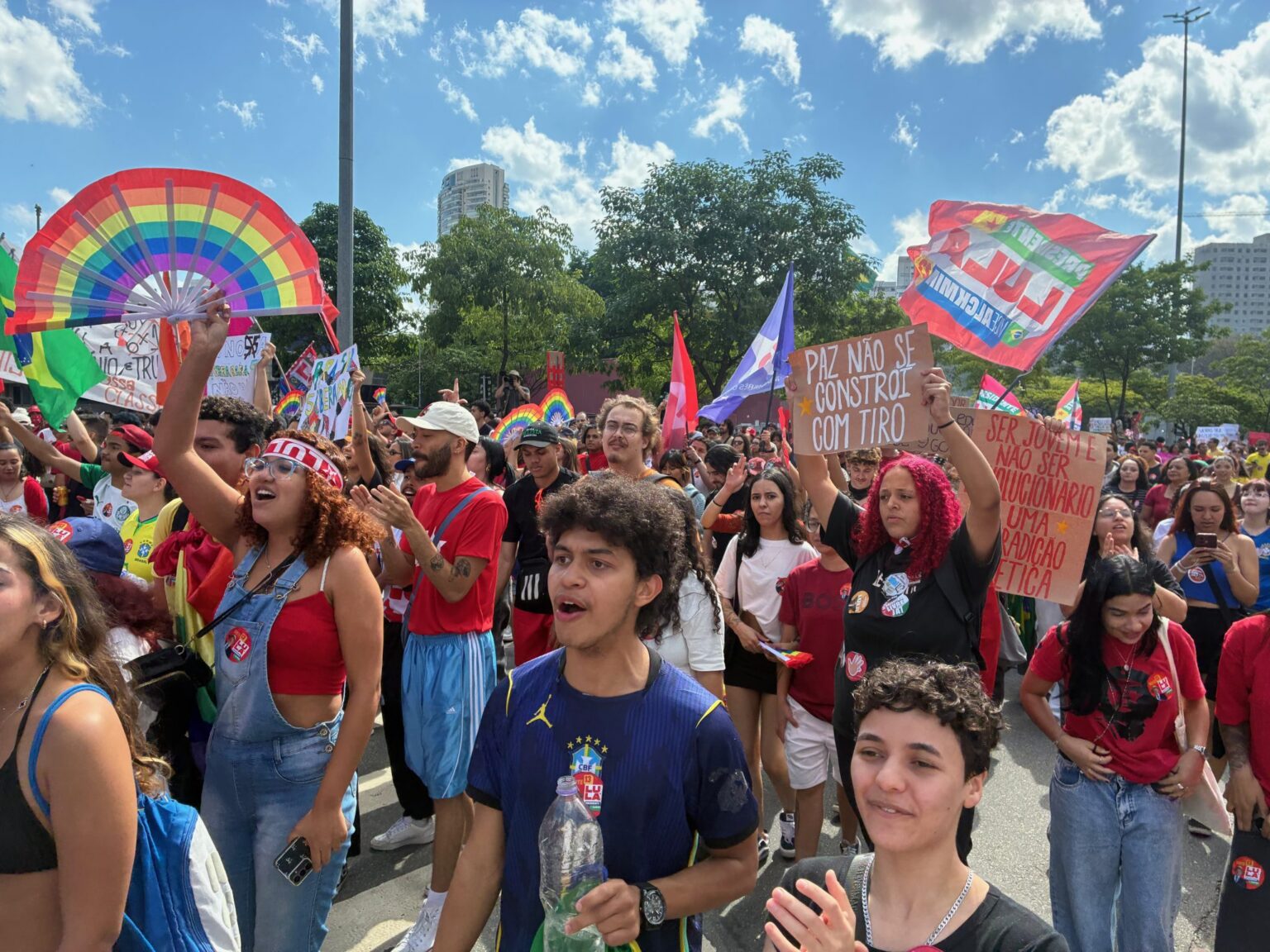
Beginning at UFF university in Niterói (Rio de Jaineiro) on the evening of October 5 and spreading across the country in the following days, assemblies and street demonstrations were independently organized by the student movement. The students in the streets showed the way, which was soon followed by broad sectors of the working class and the general population.
All of this came together to create some of the most significant mass gatherings in the country’s history, involving millions of people. Along with the massive demonstrations on Paulista Avenue (Sao Paolo) and in Copacabana (Rio), street protests took place in every state capital and in hundreds or thousands of municipalities across the country.
The sense of collective strength and confidence in the ability to turn the tide—which emanated from the streets—spread rapidly and was reflected at every level. This sentiment led to the criminal actions of Big Tech on social media—and their algorithms, which consistently favor the far right—being partially neutralized by the actions of millions of people.
The most notable example of this was the “Lula’s Army” WhatsApp channel, created by Congressman Janones (REDE party)—initially outside of Lula’s official campaign—which brought together as many as 11 million people acting in a coordinated manner on social media.
Lula’s victory, however, was not achieved solely through an online campaign. It happened because millions of people did not limit themselves to staying behind their screens but took to the streets, demonstrating an invincible force. The takeovers of the streets and social media complemented each other in a massive grassroots movement that went far beyond the limits of the campaign as it had been up to that point.
Both the initiatives on the streets and on social media emerged outside the official coordination of Lula’s campaign. Gradually, they were channeled through the campaign, but they served to overcome the enormous limitations, mistakes, and political constraints imposed by Lula’s campaign leadership since the first round. Without this, the outcome would have been different.
Against Bolsonarism, Despite the Limitations of Lulism
The majority Flávio Bolsonaro secured in the first round dismantled the house of cards built by Lula’s campaign leadership—the notion that simply highlighting how wonderful the current government had been would naturally lead to reelection. They had even gone so far as to spread the illusion that they could win a definitive victory in the first round.
The October 4 result was like a cold shower. At first, it sparked panic, despair, frustration, and confusion. But the stark realization that Bolsonarism could in fact return to power soon gave rise to anger, fear, and outrage. The arrogance and brazenness displayed by Flávio Bolsonaro and his allies immediately after the vote, as well as the announcement of attacks such as the promised “tesouraço” (including over 200 billion reais in cuts), served as yet another provocation.
A new dynamic emerged when broad sectors of the youth took it upon themselves to defeat the far right. It was not just a matter of supporting Lula, but of defeating Bolsonarism and all the evil it represents.
The sympathy for Lula, which has grown even among this new generation, is based on his working-class origins and his history linked to the struggles of the working class and the oppressed. But, as is usually the case in PT campaigns, this class background was mentioned only symbolically, as a mere formality. The main emphasis always ends up being placed on Lula’s ‘maturation’ as a leader, his ability to reconcile opposing forces, and the record of his achievements in government.
In this campaign, Lula’s working-class background ended up coming to the fore largely because of his opponent. One of the highlights of Lula’s campaign was when, during the Rede Globo TV debate, he had to respond to the mocking and hatefully prejudiced way in which Flávio Bolsonaro referred to his “nine fingers”.
By demanding an apology from his “posh” opponent—who had never worked a day in his life—and speaking about the reality of a 17-year-old who lost a finger in a factory press, Lula ended up—even if that wasn’t exactly his intention—conveying to millions the image that this contest, at its core, was a struggle of the working class against an arrogant and repugnant elite.
But Lula did not adopt a class-based stance during the campaign. He followed, especially in the first round, the approach he had taken during his presidency: the relentless pursuit of class conciliation, alliances with sectors of the bourgeoisie and the right, moderation, and pragmatism. The point is that, in the second round, the enormous pressure coming from below—from the streets—ultimately forced the campaign to take on a more combative tone, denouncing Bolsonarism and the far right.
The emphasis on his administration’s supposed major achievements was at the root of the failure in the first round. The success in the second round was not an endorsement of his administration. Indeed, his disapproval ratings remained high right up until Election Day, hovering between 45% and 51%. The vote for Lula was essentially a rejection of Bolsonarism, channeled through a figure who, despite the wear and tear on his administration, was perceived as someone concerned with the poorest and most oppressed segments of society.
The market wants Lula to adopt Flávio’s program
Shortly after the elections, many editorials in the major bourgeois newspapers argued that Lula should not view this victory as an endorsement of his administration—using this as a way to pressure him for changes that run counter to the demands of the streets. These establishment mouthpieces are not satisfied with Lula’s conciliatory stance, the new fiscal framework, and the austerity policies already adopted by his administration, and they want more—much more.
If Lula had pursued the “austericide” policy advocated by the spokespeople of the big bourgeoisie more thoroughly, he would have been defeated in the elections. In the first round, Lula met with business leaders and bankers to try to convince them that he is committed to so-called fiscal responsibility and will not take any risks. But this pragmatic stance was overrun by the protests, and Lula had to adjust his rhetoric.
Extremely important achievements, such as the end of the 6-day work week, are not the result of the government’s will but rather victories won on the streets. This demand emerged from social movements and was only adopted by the government after pressure from the grassroots and the risk of electoral defeat. Other measures—such as the increase in Bolsa Família benefits, the renegotiation of debts owed by families and individual small business owners, the end of parasitic online gambling “bets”, fuel subsidies and tax exemptions, and the expansion of the savings program—also run counter to the market’s fiscal austerity drive and came late, having been adopted in the context of the election.
This does not mean that Lula has fundamentally changed his policies, and this is the major risk for his new term. Deep down, bourgeois commentators are pressuring Lula to adopt the program of his opponent, who was defeated in the elections. By doing so, Lula could turn one of the most spectacular electoral victories into a fatal political defeat.
This is exactly what Dilma Rousseff (PT) did during her second term, following a razor-thin victory over Aécio Neves (PSDB) in 2014. She appointed an outspoken neoliberal to the Ministry of Finance (Joaquim Levy), adopted an austerity policy to appease the markets, and ultimately lost the support of her social base, becoming an easy target for the right. We already know the outcome: an institutional coup via impeachment, the disaster of the Temer administration, and a clear path for the rise of Bolsonarism and the far right.
The current situation is different. The balance of power in society has changed dramatically with the large-scale street protests and the defeat of Bolsonarism. The power of the streets today can prevent coup-like maneuvers and secure victories that undermine the “austericide” logic. But when the government returns to a logic of reconciliation with the markets, puts the “box of goodies” back on the shelf, and begins to implement harmful measures, wear and tear will set in, and the far right will rear its head once again.
We’ve already seen how, the day after Flávio Bolsonaro’s defeat, the markets sent their message. The stock market suffered its biggest drop since 2020, forcing the activation of the “circuit breaker”; the dollar skyrocketed; and futures interest rates rose sharply. The government’s tendency is to seek to pacify and calm the financial markets.
This is exactly what the current Minister of Finance, Dario Durigan, did when he emphasized the need to balance the public budget and advocated for a constitutional amendment that would compel the government to meet the “fiscal target”, with no margin for error. The real meaning of this is regression, accompanied by cuts and the rollback of rights.
The appointment of a new finance minister is also being considered in an effort to calm the markets. In addition to Durigan, other advocates of fiscal austerity are being considered, such as the current president of the Central Bank, Gabriel Galípolo, who is notorious for defying expectations surrounding his appointment by keeping interest rates sky-high. The recently reelected governor of Piauí, Rafael Fonteles, is also being considered, as is Vice President Geraldo Alckmin himself. All are known for their market-friendly stance and commitment to harsh fiscal austerity.
The continued struggle of workers, students, and the oppressed is the only guarantee against new austerity policies that strip away rights, attack public services, and cut investments.
Coup-Mongering and the Far Right
During the second-round voting, the far right used underhanded tactics to try to secure its victory. They also relied on the help of Kassio Nunes Marques, president of the Superior Electoral Court (TSE). The most striking example of this was the deliberate sabotage of public transportation in major urban centers, such as São Paulo and Salvador.
Complaints about this began to surface early on election day, but the TSE took no action against the officials who were orchestrating the sabotage. It did so even though the Bahia Regional Electoral Court had already ordered the arrest of the Bolsonaro supporter who heads Salvador city government’s mobility department—a man who had already left the country. The TSE waited until the very last minutes—when many polling stations had already closed—to decide to extend voting hours.
After voting concluded and in the face of defeat, the far right attempted to take advantage of the confusion generated in the final hours of voting to challenge the electoral process. But Flávio’s own party, the PL, had also requested an extension of voting hours in the south of the country due to heavy rain.
The defeat was so evident and humiliating that the far right, at least for now, has no grounds on which to once again attempt to undermine the electoral process. Flávio Bolsonaro’s shameful flight to the U.S. two days after the defeat—and his “madhouse Napoleon” letter claiming to be Brazil’s president-elect—deepened the humiliation and shame, divided the right, and is unlikely to have immediate consequences. Without explicit support from Trump—who is more concerned with the midterm elections—or from his own party, he ended up backing down from his self-proclamation as president of “Brazil with a Z” to merely “leader of Brazil.”
Any attempt to turn Flávio Bolsonaro into a new Juan Guaidó is likely to end even more pathetically than in the case of Trump’s former Venezuelan poodle. Juan Guaidó was president of Venezuela’s National Assembly and proclaimed himself president of the country in 2019 with the support of Trump—during his first term—as well as several European countries and the government of Jair Bolsonaro. After attempting a failed coup and being accused of embezzling billions of dollars, he fell from grace and today is nothing more than another chapter—somewhere between the ridiculous and the tragic—in Venezuela’s political history.
Donald Trump suffered a major defeat in the Brazilian elections. Even though he was advised to avoid openly backing Flávio Bolsonaro—because, after all, that would only help Lula—it is clear that he worked toward a victory for the far right in Brazil. Our country would be the decisive link in a series of electoral victories for the far right in countries such as Chile, Peru, Colombia, Bolivia, Honduras, Ecuador, etc.
As much as Lula prioritizes a path of agreements and reconciliation with the U.S., his victory thwarts Trump’s plans and his “Donroe Doctrine” for controlling the Western Hemisphere in the context of the imperialist power struggle with China.
At this moment, conditions are not favorable for a coup counteroffensive by the Bolsonarists with Trump’s active support. In the U.S., a defeat in the midterm elections weakens Trump. In Brazil, a more overt coup attempt in the short term would only serve to provoke an even stronger and more radicalized mass response.
The far right will undergo a process of reorganization in Brazil following this defeat. Within this reactionary camp, São Paulo Governor Tarcísio de Freitas emerged as a big winner, having been reelected in the first round and maintaining a certain apparent distance from Flávio Bolsonaro’s reckless behavior following his electoral defeat.
Although his administration maintains a heavy-handed profile—with a Military Police force that kills more and more people and disastrous privatizations—Tarcísio has managed to establish himself as a figure on the far right who is more palatable to big business, without the same risks and recklessness associated with the Bolsonaro family. He is likely to be a strong contender in future elections, even if the Bolsonaro family continues to struggle to maintain control over the far-right camp. The profile of newly elected Senator Michele Bolsonaro—Jair’s wife, who has a strong evangelical base—may also rise in prominence during this process. However, disputes and divisions among them are inevitable.
In any case, U.S. imperialism, in conjunction with the Brazilian far right, will seek to create the conditions for new attacks against Brazil. To the extent that Lula’s government maintains a moderate and conservative course, it will pave the way for this. Only the power of the streets—of the organized and mobilized working class—can serve as an effective counterweight to a future counterattack by the alliance between the far right and imperialism.
The first mobilizations, immediately after the election, against São Paulo Mayor Ricardo Nunes—an accomplice in the sabotage of public transportation during the voting—are a good indication of how the struggle must spread against the right and the far right in the states and municipalities as well.
Rebuilding the Socialist Left
Today in Brazil, we have a great opportunity to move beyond a phase of the class struggle that was marked by an offensive from the far right, big capital, and imperialism, and by a defensive stance on the part of the movement of workers, women, LGBT people, indigenous peoples, and the oppressed. This defensive stance arose partly for objective reasons, such as the greater dispersion and fragmentation of the working class, but primarily due to the passive role played by the hegemonic leaderships of the left and social movements.
The mass mobilizations of recent days have ushered in a new political situation. The sense of a powerful collective force in motion generated by the mobilizations and the victory on October 25 is what sets this situation apart. The approval of the end of the 6-day week just a few days after an electoral victory by the right in Congress and the states makes it clear that it is possible to win gains even in the face of a reactionary Congress, a corrupt and biased judiciary, and an executive branch that is vacillating, conciliatory, and complicit in the system’s ills.
The gains made by the right in the first round did not simply represent a shift to the right in society. They reflect a distorted political polarization, in which the far right positions itself as such, while the left wavers or renounces its duty to assert itself. The mass struggles of recent days open up the possibility of a genuine and clear polarization—a polarization between the classes in conflict within Brazilian society.
But for this to happen, the biggest mistake we could make is to expect the new Lula administration to take the initiative to continue the struggle. We defeated the far right by going beyond the limits set by the PT leadership and Lula’s campaign. We must continue on this same path, raising our legitimate demands and forcing institutions—including the right wing in Congress, the Supreme Federal Court (STF), and even Lula himself—to accept our demands.
The Lula 4.0 administration will not be one of struggle between big capital and the workers. It will be, as it has always been, an administration dedicated to maintaining the status quo, attempting to reconcile capitalists and workers. Given the current balance of power, we can corner the capitalists—both inside and outside the government—and win more gains. But these gains will come from the independent struggle of workers and oppressed sectors, not from gracious concessions handed down from above.
A large portion of the youth and workers who took to the streets remain wary of the vacillations and hesitations of the Lulaist leadership in the government and during the election campaign. These sectors, which should form a new generation of activists and fighters, must be the foundation of a true renewal of the socialist left in our country. A renewal that is not about trying to contest the direction of the PT or the government—an inglorious struggle doomed to failure.
The reconstruction of a mass socialist left in Brazil must involve the unity of those sectors of the socialist left that defend class independence, that are not swayed by positions in government, and that are willing to build a political organization with a genuine socialist program and strategy.
The PSOL (the Party of Socialism and Liberty) was founded to serve as a left-wing alternative to the PT’s limitations, but it was later led astray from that mission. Rebuilding the socialist left must involve those sectors of the left active within the PSOL who have questioned the direction taken by the party leadership in recent times, including its systematic capitulation to the PT and the Lula administration. But it must also involve principled sectors of the left that are outside this party and have not fallen into the opposite extreme of empty, self-proclaimed sectarianism.
A bloc or front of the socialist left, comprising left-wing activists both within and outside the PSOL, could serve as a foundation for building a political instrument of struggle far greater than the sum of its parts, attracting broad layers of youth and workers who have joined the struggle in recent weeks. This is a historic opportunity to move forward in this direction.
The winds blowing in from Europe—beginning with the mass, radicalized youth uprisings and the call for a general strike, which are spreading across several countries—point to a path of struggle against the far right, wars, the cost of living and exploitation, the climate crisis, authoritarianism, repression, racism, and all forms of oppression. Brazil must be part of this global uprising of youth and workers, raising the banner of socialism and revolution.