Crisis sharpened by new threats of war from Trump and Netanyahu
Per-Ake Westerlund, ISA International Political Committee
(This article was first published on 9 January 2026)
The latest protest movement in Iran, which began on 28 December, has spread to all 31 provinces of the country. Triggered by food inflation of 70%, demands are now being made that are directed squarely at the Islamist capitalist dictatorship.
On Thursday 8 January, reportedly the largest day of protests so far, the internet was shut down throughout the country. The regime is severely shaken, following last summer’s 12-day war with Israel and massive bombing by the US, and the loss or weakening of several of its most important allies in the region.
Although the protests early this week were not as strong as in 2022 “… the regime appears more shaken than one might think. Riot police and water cannons have been deployed in the back streets of central Tehran. Plainclothes fighters disperse people before they can gather at intersections. Schools and universities have been closed on the pretext of air pollution, a tactic to prevent mass action.” (The Economist). The schools were closed after just three days of protests.
Imported goods have risen particularly sharply in price. Ten years ago, one US dollar cost 30,000 Iranian rials; today, the price is over one million rials. “Iran’s population is growing, while its gross domestic product (GDP) is steadily shrinking. In 2010, with a population of nearly 75 million, GDP was $600 billion. Today, with just over 90 million inhabitants, GDP has shrunk to $355 billion.” (Dagens Nyheter, Swedish paper)
The first to protest were sellers of imported electronic goods in Tehran, followed by shopkeepers in the Grand Bazaar. The protests then spread rapidly. Inflation on foodstuffs is, as mentioned, 70%, and even higher on imported food. The official minimum wage is about 2 dollars per day. At the same time, the country’s ruling elite lives a life of luxury.
Youth, inflation, environment and war
The economic crisis triggered the protests, which quickly became political and directed against the regime. It is only 3.5 years since the massive movement following the murder of Jina (Mahsa) Amini, who was arrested for not following the regime’s dress code for women. ‘Woman, life, freedom’ became a movement started by young people, which spread to workplaces and also came to include the struggle of oppressed nationalities, such as the Kurds and Baluchis. The movement largely lacked democratic structures, leadership and a clear strategy for the struggle against the regime, which meant that it was crushed by repression. Over 500 people were killed and 20,000 imprisoned. However, deep anger towards the regime remains among young people, and the regime has since been forced to make concessions regarding the dress code. Students have quickly joined the latest protests.
Dissatisfaction is also growing due to climate and environmental crises, especially water shortages. As recently as November, the president, so-called reformist Masoud Pezeshkian, stated that large parts of the metropolis of Tehran may have to be evacuated due to the water shortage.
At the same time, the regime’s propaganda about its own power in the region has been undermined. Its allies have succumbed, such as the Assad regime in Syria, or been largely crushed, such as Hezbollah and Hamas. Iran’s efforts to sponsor these organisations have been shattered. Israel, with the backing of the United States, was superior in the 12-day war this summer. Now another ally of Iran, Maduro in Venezuela, has been deposed militarily by the United States. In no case has the regime in Tehran received real support from its allies in Moscow or Beijing. Militarism has not brought security.
There is real concern that the war will resume, an issue high on Netanyahu’s agenda in Israel. Trump has also made new threats in the past week. In June, Israel and the US were unable to find supporters within Iran. Workers and the poor who oppose the regime did not see the bombing powers as an alternative and wanted to end the war. But after the kidnapping in Venezuela and with increasing desperation, some sections of society may believe that the US can help.
Over 100 cities
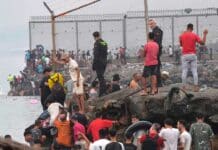
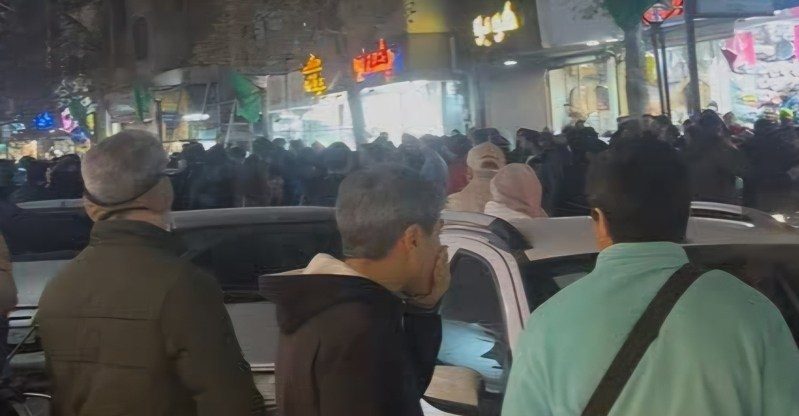
The new wave of protests has grown despite the risk of repression. In city after city, videos are being shared on the internet showing crowds of people, including several large demonstrations of women, shouting ‘Death to the dictator’, i.e. the supreme leader Ayatollah Khamenei. Reports have come from more than 120 cities in all parts of the country, including the holy city of Qom. Police stations and town halls have been stormed in several cities.
The regime is clearly concerned. President Pezeshkian was quick to point out that there is a difference between demonstrators and ‘troublemakers’. The former have the right to protest, he suggested, while the latter should be attacked as the regime usually does – with water cannons, live ammunition and arrests. Already, some 40 people have been killed and over 2,000 demonstrators arrested.
The regime has also tried to make concessions. All citizens will receive a new subsidy equivalent to about 8 dollars per month, a sum that does not go very far for families who are starving. The head of the central bank has also been replaced.
Lessons of mass movements
Iran has seen several major mass movements over the past 25 years – the student protests in 1999, the resistance to election fraud with millions on the streets in 2009, against increased fuel prices in 2019 and most recently Women, Life, Freedom in 2022-23. Several major strikes, most recently among teachers, have been organised despite the fact that independent trade unions are illegal. The Islamist regime has survived through harsh repression when the movements have become exhausted or won temporary concessions.
These movements have lacked democratically organised leadership, and the anger and demonstrations, which have lacked coordination, have not been enough. The opposition has no revolutionary socialist alternative that could show a way forward, or a strategy where the struggle of the working class is the backbone for coordinating the protests of all the oppressed.
The lack of a revolutionary alternative and increased desperation also mean that there is a risk that even Reza Pahlavi, the heir to the Shah (king) who was overthrown in 1979, could gain ground, despite having lived in exile for almost 50 years and not representing any democratic alternative or improvements for the poor.
Threat of war
The threats from Netanyahu and Trump must be taken seriously. The hubris of both men could trigger a new war. Trump’s statement that the US army is ‘locked and loaded’ is an unanswered threat and, of course, has nothing to do with protecting protesters, as Trump claims. As in Venezuela, it is about natural resources and power in the world. A new war in the Middle East would be at the expense of the region’s people and risk spreading if Iran were to respond with missiles against Israel and the Gulf states.
The alternative for the regime in Tehran is a humiliating agreement on Trump’s terms, with the hope of lifting the sanctions that are contributing significantly to the economic crisis. This was part of President Pezeshkian’s promises when he took office 1.5 years ago. It would also be in Trump’s interest for the regime to continue to keep workers and protesters in check. Imperialism does not want mass movements on the streets that it cannot control.
The new protest movement in Iran is no surprise. It once again exposes the brutal dictatorship that rules. Now the lessons of previous movements and international workers’ struggle must reach those who are fighting. Democratically-organised strikes across the country, leading to an indefinite general strike by the entire working class, are important steps towards what is needed to bring down the regime.
- Support the struggle of workers and young people in Iran. Fight against dictatorship and capitalism, for a socialist transformation of society.
- No to war against Iran. Stop Netanyahu and Trump’s threats.