A test case for Beijing’s brutal National Security Law • Media freedom crushed
Kau Tsing, Solidarity Against Repression in China and Hong Kong (SARCHK)
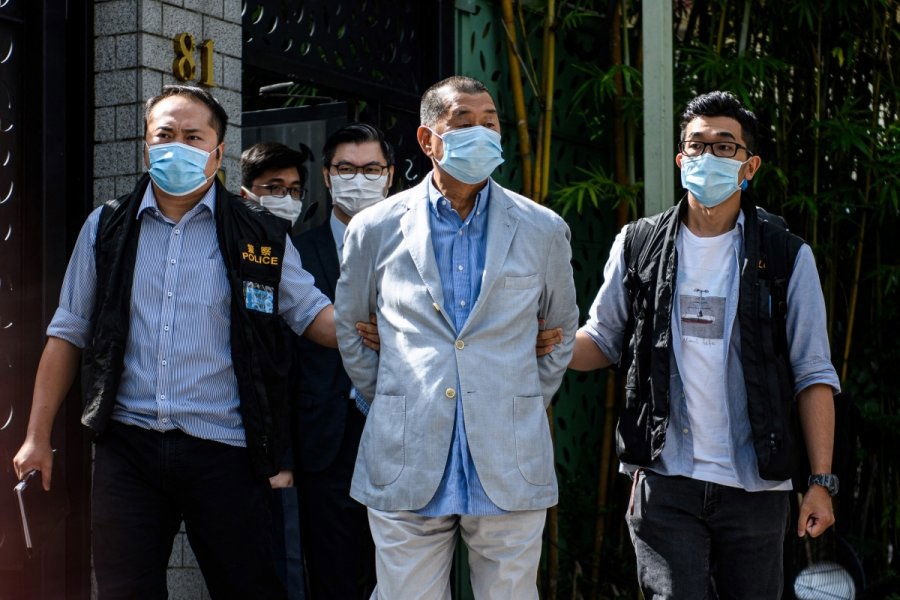
Jimmy Lai, the Hong Kong media tycoon prosecuted under the draconian National Security Law, has been sentenced to 20 years in prison! At 78 years old and in poor health, this sentence means he will “die in prison” according to his son. Six of Lai’s former media employees and two other political activists were sentenced to between 6 and 10 years at the same trial. Lai pleaded not guilty to the charges, the others pleaded guilty in the hope of lighter sentences.
This trial is a deterrent tactic by the Chinese dictatorship (CCP). As of last June, the CCP and Hong Kong government had arrested 332 individuals under the National Security Law, with 165 convicted. The CCP uses extremely harsh penalties and a conviction rate exceeding 95 percent to strike fear into anyone in Hong Kong who dares to voice dissent.
A big part of the CCP’s determination to punish Lai was to smash any elements of an independent media, outside of CCP control. Other publications were threatened and closed down after Lai’s Apple Daily ceased publication in 2021. Press freedom in Hong Kong has experienced a huge decline since 2010. According to Reporters Without Borders (RSF), the ranking has plummeted from 34th in the world in 2010 to 140th in 2025.
Political show trials with severe punishments are the CCP’s method for achieving total control over Hong Kong, as in the whole of China. One of the two charges against Jimmy Lai was unrelated to the National Security Law (instead stemming from the “sedition” charge established under British colonial rule), demonstrating that the British era in Hong Kong was far from the “democracy” that some, ironically including Lai himself, portray it to be.
Lai is a British citizen. His sentence is the latest in a series of shockingly harsh court verdicts since the CCP instigated a political counter-revolution against the mass democracy movement in 2020.
In response, Western bourgeois democracies merely offer feigned, feeble “condemnations” and “concerns,” prioritizing the preservation of economic and trade ties with Xi Jinping’s government over the democratic rights of ordinary people in Hong Kong and China. During British Prime Minister Keir Starmer’s visit to China, Jimmy Lai’s case was just a footnote, while Starmer secured multibillion-dollar agreements to access China’s energy, pharmaceutical, and drinks markets.
US President Trump makes no secret of his deep affection for Xi Jinping who he calls a “very respected leader” while eagerly preparing for his April visit to China. Trump has merely “mentioned privately” the Jimmy Lai case.
Lai has always been a controversial figure. He owned Apple Daily, which was the only large circulation newspaper to support pro-democracy politicians, the demand for universal suffrage, and oppose the pro-CCP Hong Kong establishment. But this “support” was reserved for the most reactionary, anti-struggle and pro-US trends within the democracy movement. Lai had close ties to the US right especially Republicans. Apple Daily often identified also with the “nativist” wing of the anti-CCP movement – right wing nationalists and racists with massive illusions in US imperialism.
SARCHK protests the political prosecution and harsh sentence against Jimmy Lai, while we also distance ourselves completely from the political line of his newspapers. SARCHK and our co-thinkers in Hong Kong’s democracy struggle stress the need for mass action, strikes and working class organisation as the only force that can defeat dictatorship and achieve democratic rights such as free speech, freedom of assembly and freedom of political parties (all now abolished in Hong Kong).
There should be absolutely no trust in hypocritical capitalist governments and politicians who pay lip service to “democracy” while standing for authoritarian measures in practise (witness Trump’s deadly military crackdowns in major US cities).
We wonder what Lai must feel today when his “friends” like the rulers of the US and Britain are shedding crocodile tears but have not lifted a finger to pressure the Chinese regime to release him and other political prisoners.