Xi Jinping’s June visit to Pyongyang revealed a CCP regime on the backfoot, needing to shore up China’s influence in its geopolitical “backyard”
Vincent Kolo, chinaworker.info
North Korea’s Kim Jong-un used Chinese president Xi Jinping’s visit on June 8-9, officially to mark the 65th anniversary of China’s only existing defence pact, to showcase the Pyongyang regime’s military advances and its ‘graduation’ as a fully-fledged nuclear power. The message from Kim’s regime was that North Korea’s nuclear weapons program is not on the table for negotiations. North Korea has around 60 nuclear warheads, with enough fissile material to make 20 to 30 more. Beijing’s position changed around two years ago from advocating “denuclearisation” of Korea to no longer mentioning this while not formally renouncing it either.
Xi’s visit was significant for several reasons. This was his first and so far only foreign visit of the year. He is scheduled to go to the United States in two months. This contrasts with visits to four countries in the first half of 2025. Presidents Trump and Putin went to Beijing for separate visits in May, as did more than 20 other leaders of foreign governments so far this year.
To some, this abnormal level of one-way diplomatic traffic is a sign of Xi’s and China’s growing strength on the world stage. It shows the CCP (so-called Communist) dictatorship is more powerful than ever, they conclude. Foreign media reports claim the CCP has adopted a “home court” model of diplomacy, letting the world come to Xi’s door in accordance with his increased standing.
We believe this is yet another example of the international commentariat completely misreading processes in China. The Xi regime has in reality been significantly weakened in the past few years, continuing into the first dramatic months of 2026. Firstly, this is due to a debilitating economic crisis rooted in a five-years-and-counting property crash, unleashing a Japan-style debt crisis, deflation, subdued growth, weak domestic demand and – in China’s case – mass unemployment.
Secondly, the economic downturn has aggravated factional tensions within the Chinese capitalist class and regime, processes largely invisible to the public at large, but noticeable in the unending wave of military purges and disappearances, which are also unprecedented in the 99-year history of the PLA (People’s Liberation Army, the CCP’s military wing).
CCP on hard times
The mistaken ‘Xi is stronger than ever’ analysis, does not even consider that this internal CCP and PLA power struggle could be an important factor keeping Xi from traveling – fearing possible moves against him in his absence, or preferring to be ‘hands on’, or probably both. Even within the country, Xi has only left the capital, Beijing, on four occasions since November 2025, for short tours, which is also noteworthy.
While the CCP’s main antagonist US imperialism is in deep trouble, boxed into an apparent ‘forever war’ with Iran, which puts the fate of the global capitalist economy on a knife-edge, this year has also been a year of serious setbacks for Xi and Chinese imperialism. The limits of its ability to project strength, openly challenge the US and defend its allies in crucial regions such as Latin America and the Middle East have been exposed. China’s economic power – mainly its export dominance – is still formidable, but the limits of its geopolitical power are being laid bare in Venezuela, Panama, Iran and Cuba.
The CCP’s economic strategy requires clinging on to what remains of capitalist globalization, increasingly a bygone era, to be able to absorb China’s exports and prop up its struggling economy. This also requires, for the time being, avoiding an escalation of the US-China conflict by adopting a de facto deferential position towards Trump.
The last time Xi went to North Korea was in 2019 and that year he also visited Brazil, France, Greece, India, Italy, Japan, Kazakhstan, Nepal and Russia. During this diplomatic outreach he welcomed the first G7 country, Italy, into China’s imperialist mega project, the BRI (it left in 2023). The China-led BRICS forum, which Xi attended in Brazil in 2019, was then widely viewed as a possible alternative to Western imperialist hegemony.
Nowadays, it seems that Xi has lost interest in attending BRICS summits because of that group’s limitations and internal divisions. Iran is a full member of both BRICS and the CCP-led Shanghai Cooperation Organisation (SCO), but the reader will be hard pressed to find a record of any protest, let alone action, from these bodies in support of Iran as it is attacked by the US. The SCO, which is ostensibly a forum for regional security (!) called for “restraint” from all sides and appealed to the United Nations to “defend peace”. BRICS could not even manage a verbal protest: A May meeting of the bloc in New Delhi could not agree on a final communiqué – the UAE, another BRICS member, whose regime is the most pro-war and pro-Israel of the Gulf dictatorships, opposed any statement of solidarity with Iran.
This paralysis confirms ISA’s assessment of BRICS as something akin to a “paper tiger”. It is not an actual trade bloc nor is it unified around any plan or vision to challenge US hegemony, contrary to the illusions of some groups on the left.
It is therefore more than symbolic that Xi’s only foreign visit so far in 2026 is to North Korea, a longtime underling and dependent, which Beijing now worries is straying too far under Russia’s sway.
Nuclear program
Historically, US imperialism is the number one cause of the North Korean regime’s relentless push to develop nuclear weapons. The US has never signed a peace agreement with North Korea since the Korean War and US-led invasion of 1950-53.
In 2017, zigzagging between escalatory threats and the hope of striking a historic nuclear deal, first-term Trump threatened to “totally destroy” North Korea – language that today is addressed to Iran on a regular basis. Currently lacking a nuclear bomb, Iran has been subjected to an aerial bombardment by the US and Israel unprecedented in the history of warfare. That war, the abduction of Nicolás Maduro in Venezuela, and Trump’s escalatory attacks on Cuba are viewed from Pyongyang as full vindication for its nuclear weapons program.
The Kim Jong-un regime has used its nuclear program as a strategic tool to remain in power despite decades of severe international sanctions, to reinforce the idea that only the “supreme leader” can safeguard the country against military attack and also to reinforce brutal totalitarian rule. The consolidation of Kim’s rule over the past two to three years as a result of his very profitable alliance with Putin’s Russia has led to further increases in repression, surveillance, forced labour and invasive personal controls to sniff out any signs of dissent. Outside of the relatively prosperous capital city of Pyongyang, half of North Koreans live in absolute poverty and 11m of its 26m population are undernourished.
The Ukraine war and Russia’s reliance on North Korean munitions and manpower have facilitated a strategic pivot by Kim’s regime away from its previous positions: Korean reunification, “sunshine” negotiations with South Korea, and attempts to gain economic concessions and sanctions relief from Western imperialism. In March, the regime deleted the longheld call for “Korean reunification” from its constitution. It also deleted the word “socialist” from the title of the country’s constitution. This was significant, as a further step away from “ideology”, even though the constitution and regime have never been socialist.
These latest amendments formalise the sharp reorientation that started two years ago, which tore up more than a decade’s worth of attempts by Kim and his father Kim Jong-il to reach an accommodation with US imperialism and its allies.
In 2024, the regime demolished monuments to reunification – including a famous monument built by Kim’s father – and destroyed road and rail links leading to the South. The propaganda content of the new policy is that Kim’s regime is now strong, independent, “and nuclear” – it has no use for agreements with Seoul or Washington. Nuclear acceleration is built into this new course.
Four days before Xi Jinping touched down in Pyongyang, Kim unveiled a new nuclear processing plant with claims this will boost the production of weapons grade nuclear material by 75 percent. There will be an “exponential” expansion of North Korea’s nuclear forces, he boasted. In late May, North Korea’s military tested its own version of the American HIMAR rocket and also a purported “AI guided” cruise missile.
Whether these achievements are exaggerated or not, the messaging on the eve of Xi’s visit was unmistakeable: North Korea is now a stronger asset within the anti-Western bloc, which includes China and Russia, so its price is rising. While there were smiles all around, it is clear that Xi’s mission was to remind Kim’s regime that in their complex triangular relationship it is China, not Russia, that is top dog. For their part, the North Koreans were happy to set off a bidding war between Beijing and Moscow.
China has for three decades been the dominant power and “benefactor” for the North Korean regime, which seemed close to collapse on several occasions during this period following the collapse of Stalinism and the USSR. China accounts for more than 90 percent of North Korea’s total trade. But the ties Kim has forged with Putin since the start of the Ukraine war have significantly strengthened his hand internally and within the wider geopolitical chess game of Northeast Asia. This has diluted China’s formerly exclusive leverage over North Korea causing growing concern in Beijing.
The Russian connection
Clearly, Xi did not undertake this trip to unlock significant economic deals. China’s economy is around 1,000 times bigger than North Korea’s. Xi’s mission was to steady a historically prickly but crucial geopolitical alliance.
In the inter-imperialist power struggle, with Trump’s aggressive militarism suffering a major setback in the Middle East, but still not extinguished, the CCP needs a Russia that is not too strong but also not too weak. Putin’s growing influence over North Korea is an irritation for Beijing, but Russia’s alarming recent setbacks in the Ukraine war are a bigger concern, even if a continuation of the military stalemate of the past few years is still the most likely.
While its diplomacy is vague and evasive by design, the CCP does not oppose North Korea’s involvement in Putin’s war effort, because its bottom line behind fake expressions of “neutrality” is that Russia must not lose the war. At the same time Beijing is unnerved by the scale of sensitive Russian military technology transfers that Kim Jong-un has been able to extract in exchange for his support.
Exports of Russian oil to North Korea have increased nearly tenfold since 2022 to around 1.5 million barrels per year. This is far above UN sanction levels, but with Russia itself the world’s most sanctioned country, the international sanctions against Pyongyang are no longer its problem.
Of even greater importance to Kim’s regime is access to previously off-limits advanced military technology. North Korea has sent between 9-12 million artillery shells and up to 20,000 soldiers as “cannon fodder” to Putin’s war. South Korean sources put the North’s losses at 6,000 killed or wounded.
In return, Russia has given North Korea air defence systems, advanced satellite and space-based technologies, GPS jamming and electronic warfare equipment and improved missile launch technologies. Pyongyang may also have obtained nuclear propulsion systems to upgrade its submarine fleet.
Historically, both Beijing and Moscow have refused to pass such military technology to Pyongyang, fearing the consequences of equipping such an unpredictable and unstable regime with advanced weapons systems. It is precisely this Russian military support that has been a game changer, strengthening Kim’s hand and increasing his regime’s geopolitical wiggle room.
Historical roots
Historically, going back to when the three neighbours were Stalinist regimes (non-capitalist dictatorships that claimed to be ‘socialist’), there was never any genuine trust or comradeship in their relations. Every Stalinist dictatorship was fundamentally nationalist. They pursued narrow national economic planning that leaned towards autarchy, and they defended the privileges and power of a national bureaucratic elite.
Kim Jong-un’s grandfather, Kim Il-sung, first developed the skillful while thuggish art of balancing and creating competition between his two gigantic “socialist” neighbours. On more than one occasion he jailed and executed pro-CCP and pro-Soviet factions within North Korea’s ruling elite. The relationship between these states, continuing through the process of capitalist restoration, has always been transactional and fraught with tensions under a mask of “solidarity”.
A glimpse of this reality is given in the recent memoirs of Mike Pompeo, who visited North Korea in 2018 for talks with Kim Jong-un as Secretary of State in Trump’s previous administration. Pompeo recalls that he told Kim, “The CCP always tells the US that if American troops leave South Korea, Chairman Kim will be very pleased.” To this, Pompeo says “Kim excitedly struck the table with his hand and shouted, ‘The Chinese are liars!’”
According to Pompeo’s account: “Kim said he needs US forces in South Korea to protect himself from the CCP, and that the CCP wants the US military to withdraw so they can treat the Korean Peninsula like Tibet and Xinjiang.”
While Pompeo, who harbours ambitions of becoming the next right-wing US president, has his own reasons for presenting their talks in this way, there is nothing shocking or unbelievable here. Kim’s point about US troops in Korea and the CCP’s ambitions, reflected his policy at that time – for an accord with US imperialism – while his regime’s dislike and distrust of the CCP is not news. In 2013, Kim Jong-un executed his uncle, Jang Song-thaek, who was regarded as a go-between for Beijing. This was a warning to Xi’s regime and also to other “pro-China” elements in North Korea’s ruling circle.
Superficially, the Pyongyang summit confirmed the “unbreakable friendship” between the Chinese and North Korean regimes. But reading between the lines, the North Korean side understands they are dealing with a Chinese leader who has been weakened – who has not successfully stood up to Trump in Venezuela, Panama or Cuba – and a Chinese regime that is shakier at home.
The two-day visit saw the Korean hosts deliver several diplomatic slights and subtle put downs. The crowd mobilised to greet Xi was only one-tenth the size of his previous visit in 2019. On a stone plinth unveiled to commemorate the two countries’ 1961 treaty, Kim’s name was written in larger script than Xi’s. This is reminiscent of the scene in Chaplin’s film ‘The Great Dictator’ when the German fürhrer Hynkel and his Italian counterpart Napaloni compete to sit higher by repeatedly raising their barbershop chairs.
For dictatorships such as the Kim and Xi regimes, state visits and top-level diplomatic exchanges are choreographed down to the smallest detail, according to a strict hierarchical pattern that makes other country’s diplomacy look unscripted and impromptu by comparison. Such seemingly petty details therefore invariably have a significance and are rarely accidental.
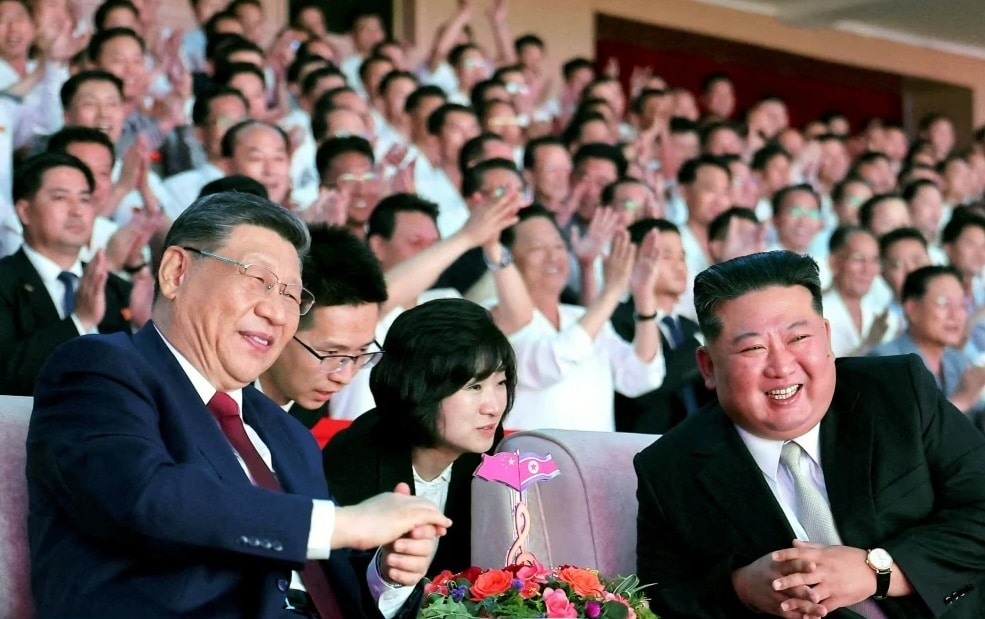
Another example of this were the photos from Pyongyang of Xi Jinping wearing eyeglasses during a musical performance. These were broadcast by North Korea’s state media. But such images have never been seen in China. Chinese media and internet promptly censored all the Korean photos of a bespectacled Xi, in defence of their ‘strongman’ and his officially flawless vision.
Regional perspective
The Kim regime has achieved a degree of stabilisation and room to manoeuvre. This should not be overstated. Much will change when the Ukraine war finally ends. Xi Jinping was nevertheless forced to break his self-imposed travel ban in order to bring Kim “into line” and address new and serious issues for Chinese imperialism and the CCP-state portending to the increasingly unstable and dangerous global environment. These include the pressure from a re-militarising Japanese imperialism which is pushing forward aggressively with its alliance-building with South Korea, Australia and other regional states amid uncertainty over the US role in the region.
Historically, and still today, the Chinese regime needs North Korea as a buffer against US power and its 28,000 troops stationed in South Korea. Previously, the CCP opposed the North’s nuclear arms program, officially favouring “denuclearisation”, because it feared this could set off a chain reaction pushing Japan and other rivals of Chinese imperialism to develop nuclear weapons. Technically, this is something Japan could accomplish quite rapidly – within weeks – which is why it is described as a “para nuclear” or “nuclear-latent” state.
In the new situation, however, the main focus of Japan’s right-wing nationalist Takaichi government and its huge militarisation drive is openly stated to be China, with North Korea as a footnote. Hence the CCP has begun to backpedal on “denuclearisation” for Korea.
If US imperialism was ever to abandon its decades-long East Asia strategy, to pull back from Taiwan, withdraw its forces from Japan and South Korea – replicating the nascent trend underway in Europe – the likely outcome would be the development of nuclear weapons by several of today’s US allies and an even more furious arms race across the region.
The New York Times described North Korea’s recent geopolitical rise as a “miraculous transformation”. It stands in sharp contrast to three decades of extreme isolation and internal turmoil that followed the collapse of the USSR and other Stalinist regimes in the early 1990s. Kim “is recognized at home and abroad as North Korea’s most powerful leader to date, surpassing even his grandfather [Kim Il-sung], the country’s founder, because he has achieved the status of a de facto nuclear power,” noted Choe Sang-Hun in the same Times article.
Denuclearisation is off the table
The survival doctrine of the North Korean regime, under the absolute monarchy of the Kim family, is based on a “war economy”, with vast networks of private capitalists (“money lords” – donju) accounting for around 50 percent of GDP, under an authoritarian militarised state control, with the nuclear weapons program at its core.
Expressing the new realities of 2026, the nuclear weapons issue was expunged from the June summit agenda whether Xi Jinping had wanted to raise this or not. The North Koreans used Xi’s visit to send a message to the US, Japan, and others, that its nuclear weapons program is not up for negotiation – even Xi Jinping cannot change our minds!
The day before Xi’s arrival, Kim Yo-jong, the ruler’s sister, also a leading figure in the regime, announced in the regime’s newspaper Rodong Sinmun that the country’s status as a nuclear weapons state is an “absolutely non-negotiable” and “irreversible red line”. She stated that Pyongyang’s nuclear forces are meant for actual combat deterrence, not for diplomatic bartering.
After the Xi-Trump summit in May, the official White House readout claimed the two sides had “confirmed their shared goal to denuclearize North Korea”, while this explicit formulation was noticeably missing from Beijing’s version, which only mentioned “the Korean Peninsular issue”.
Possibly, the North Koreans suspected the CCP leaders had made private commitments to Trump. We cannot exclude that a section of the CCP regime might want to use this as a bargaining chip, for extending the trade truce or in a future trade-off over Taiwan. Therefore, Kim’s regime used the Pyongyang summit to make clear that this door is closed. The US claims were “false information” and a “complete fabrication” read Kim Yo-jong’s statement. This was to put pressure on Xi and at the same time underscore North Korea’s strategic pivot away from nuclear negotiations and reunification.
East Asia is a crucial economic region for global capitalism, following several decades of unprecedented industrialisation, where imperialist power struggles and the dominant US-China rivalry are now increasing in tempo. Capitalist regimes are all to one degree or another pursuing right wing nationalist and militarist agendas, posing terrible dangers for the working masses of the entire region. Marxists analyse not for its own sake but in order to organise and build an international socialist alternative, which is the only way out of this unfolding nightmare.