April 1, 2026 Per-Åke Westerlund, ISA International Political Committee
Iran has been at the centre of global events continuously for more than a century. Imperialist powers dominated the entire period up to the revolution in 1979, treating Iran as “a semi-colonial country, half-industrialised and half colonial”, leading Marxist Ted Grant concluded in 1979.
Iran has also seen revolutions in 1906 and 1979, numerous waves of uprisings and revolts, national liberation struggles and even an attempt to form a Soviet state. The mass struggle in January 2026 and the present war are further chapters in the rich history of the country.
In the first years of the 1900s, mass opposition grew in several authoritarian states. This culminated in revolutions in Russia in 1905, Persia (Iran) in 1906 and the Ottoman empire in 1908. The Russian Revolution in 1905 played a key role in inspiring the masses in Persia. The repression of the tsarist empire was heavily felt there also, and the Russian masses showed it was possible to fight it.
Bourgeois historians describe the revolutions in Persia and by the Young Turks in the Ottoman empire as “constitutional”, aiming for modernisation. The success in achieving a new constitution in Iran is compared with the defeat of the Russian revolution 1905. The new constitution, however, meant little for the masses in Persia regarding democratic rights or living standards. In recent mass struggles internationally since 2019, the ruling class offering a new constitution to wind down mass movements has played a similar role. In Russia, the lessons of the 1905 defeat, including the formation of workers’ councils, the soviets, formed the basis for the Bolshevik Party leading the working class to power 12 years later, in 1917.
Oil and Occupation
In Persia, one year after the revolution in 1906, Russia and the British empire signed a secret agreement, the St Petersburg deal, in which they divided Persia into two spheres of interest (one each) and one neutral zone. In 1908 there was a military coup, with some Russian support, that led to a civil war. Armed forces from the provinces defeated the national army and re-installed the “constitutional monarchy”.
From 1908 Persia, became a key global target for plunder when oil was discovered, the first findings in the Middle East. Every major imperialist power now aimed for control of the region and Persia itself. This was made clear in World War I, when the country was occupied by Russia and Britain. The country became a front line in the war against the Ottoman empire. The huge suffering of the population of Persia during the war led to massive hatred against the occupying powers.
Following the Russian revolution, in which the Bolsheviks and the working class broke with imperialism, Britain became the sole imperialist dominant in Persia. The war ended in mass famine, in which approximately two million died. Both Britain and the US rejected requests for aid.
The power of the angry masses was restrained by the suffering, but above all by the lack of a strong workers’ party. This opened the way for the dictatorship of Reza Shah. In 1921-25 he gradually established his rule. On one hand, he wanted to promote modernization, with Ataturk’s regime in Turkey as a model. This included introducing a ban on the veil. On the other hand, Reza Shah promoted Persia’s more than two thousand year-old history. He took the name Pahlavi from the dominant language of Persia before it was converted to Islam.
World War II
Reza Shah also understood the strong anti-British mood in the country and gradually became more pro-German, openly supporting the Nazi regime from 1933. In the 1930s, he renamed the country Iran (meaning the country of the Aryans). His turn towards Germany was seen with alarm by the allied powers in WW2, and Iran was again occupied by Britain and the Soviet Union. Reza Shah was forced to resign and go into exile. However, his son, Mohammad Reza Pahlavi, became the new king with the support of both London and Moscow.
When WW2 ended, the northern regions that had been occupied by the Red Army formed their own Soviet republics in Azerbaijan and Kurdistan. Their ambitions were both national liberation and to establish socialism. As in most countries, the Communist Party of Iran grew rapidly at the end of the war. The party had a strong presence in major workplaces as well as in the army.
However, the Iranian CP was completely subordinate to Stalin’s regime in Moscow, which did everything to suppress independent movements of workers in all countries. Stalin’s deals with British and US imperialism gave him control of Eastern Europe in exchange for accepting imperialist counter-revolutions in Greece, Iran and elsewhere. This included Moscow accepting that soviet republics in Iran be dissolved.
1953: The CIA-Led Coup
Imperialism had to struggle to stay in control of Iran, despite support from Moscow. With the Communist Party seeking alliances with “progressive capitalist forces”, room was left for the liberal nationalist National Front. Its leader Mohammad Mosaddeq opposed foreign interests, including the Soviet Union, in the oil industry and pushed for nationalisation. The British oil industry major, the Anglo-Persian Oil Company (now named British Petroleum – BP), owned 51% of all oil reserves in the country.
As Prime Minister, Mossadeq carried out the nationalisation of oil in 1951. Similar to some other governments which were feeling the pressure from below in the post-war period, he also introduced some progressive reforms. Imperialism, however, could not accept losing control of Iran’s oil production and reserves. In 1953 the CIA led a coup against Mossadeq. Like other liberal and social democratic leaders, Mossadeq underestimated the threat and told the masses who mobilised in support of the regime to dissolve and return home.
US Imperialism and the Shah
The coup gave the shah, Mohammad Reza, full power as an ally to US imperialism. British and US companies were granted 40% each of oil production, with French and Dutch companies sharing the remaining 20%.
US imperialism was now in control. As Ted Grant explained in one of his articles in 1979, Iran was “a semi-colonial country, half-industrialised and half colonial.” Stalin’s regime in Moscow accepted this new order, wanting stability above all and also to keep its trade with Iran, including imports of liquified natural gas, LNG.
US imperialism wanted the Iranian regime as a bastion in the region, to secure oil and prevent revolutions. This long-term interest is also an important factor in the present war, and counters the argument from some on the left that Washington only acts on behalf of Israel. US imperialism clearly has its own interests in this war, not least the inter-imperialist conflict with Chinese imperialism.
In 1957, the FBI assisted the Shah to establish his notorious and extremely repressive police, SAVAK. This force became synonym with murders, torture, disappearances and massacres. In 1975, the Shah officially declared Iran as a one-party state. His deal with imperialism also gave a substantial income for the Shah, up to 50% of oil profits. This became the basis for a broad industrialisation. A “land reform” mainly benefitting large landowners forced a rapid urbanisation. Former rural youths became the new working class.
There was still a strong mood against US and British companies and their support for the repression of the Shah regime. This was exploited by Islamist scholar, Khomeini, who became one of the most powerful voices against the selling out of Iran to foreigners and the corruption of the elite. He was then attacked by the regime and forced into exile, which gave him enhanced status as an opposition leader. Mosques mushroomed and there were 50,000 of them in 1979. They also functioned as support organisations to poor families, This was in a situation where political parties were illegal, and the Communist Party was ordered by Moscow to support the Shah’s industrialisation.
Left-wing groups critical of Moscow were instead influenced by Maoism and the idea of guerilla struggle. That meant prioritizing armed groups in the mountains instead of the strong working class in the cities. Some groups also looked towards some kind of radical Islamism, “red shia.” Many confused left groups thought they shared an opposition to capitalism in common with the Islamists.
The Shah lived in luxury and decadence, trying to balance between his “modernisation” and the influence of Islam. He had the strongest army in the Middle East and was internationally considered as leading a stable regime. The revolution came as a shock.
1978-79 – Years of Revolution
No revolution falls from the sky; the signs are there long before. In Iran, protests against repression, corruption and imperialism started with students and young people. This was a revolution: in 1978 the masses entered the scene and society could not continue as before. When the repression killed thousands of protesting youth, the working class joined the struggle.
The regime, as with mass protests in the 2020s, responded with a combination of some concessions and continued repression. Concessions strengthened the protest movement. A new stage was reached with thousands killed by SAVAK in September. Workers in the oil, steel and other industries went on a strike that developed into a four-month general strike.
The revolution could be seen everywhere. The military started to disintegrate, with soldiers siding with the workers. Left-wing organisations grew rapidly. Newspapers and debates mushroomed. Trade unions grew rapidly, often naming themselves as Marxist. Unfortunately, Moscow, Maoism and various small left-wing groups had the strongest influence.
After its humiliation in Vietnam, there was no possibility for the US to intervene in Iran. On 16 January, 1979 the Shah fled the country. But what force would lead this revolution? On the ground it was youth and workers, but at the top?
Khomeini, known for his messages from Paris, portrayed himself as the Supreme leader against the US and the Shah. When he came back to Tehran in February 1979, millions were on the streets. There was no strong left-wing alternative. The stalinist Communist Party (Tudeh) and the strong Fedayeen Majority (Maoist influence guerrillas) gave him their support, asking for alliances.
Despite the weakness of the fast-growing left, the struggle of the working class continued and developed further. Workers councils, called Shoras, were formed in the workplaces. The youth aimed for revolution, but as Ted Grant pointed out “But revolutionary students in Iran were not directed either towards the working class, or to formulate a programme for working class action, but on the contrary were told by the sects to turn to the impotent methods of individual terror.”
Khomeini and the mullahs portrayed themselves as democrats and claimed to favour restoring the constitution of the revolution in 1906. The pressure of the masses pushed Khomeini to much further than he originally wanted. He nationalised banks and major parts of the economy, and introduced “free medicine and transport, cancellation of power and water bills and the putting aside of £500 million in the budget to subsidise essential consumer goods.” (from Militant International Review)
Before Counter-Revolution
The events of 1978-79 were a major blow against imperialism and capitalism. This explains the revenge especially the US ruling class has longed for over the decades since.
The confrontation with US imperialism confused much of the left at the time. The Communist (Tudeh) party, following Moscow, asked Khomeini for a joint People’s Front. The Fedayeen Majority asked to be included in the government. The People’s Mujahedeen was in favour of “loyal” capitalists. None of them put forward a socialist program or independent working-class policies. Most small left-wing organisations also praised Khomeini’s radical policies.
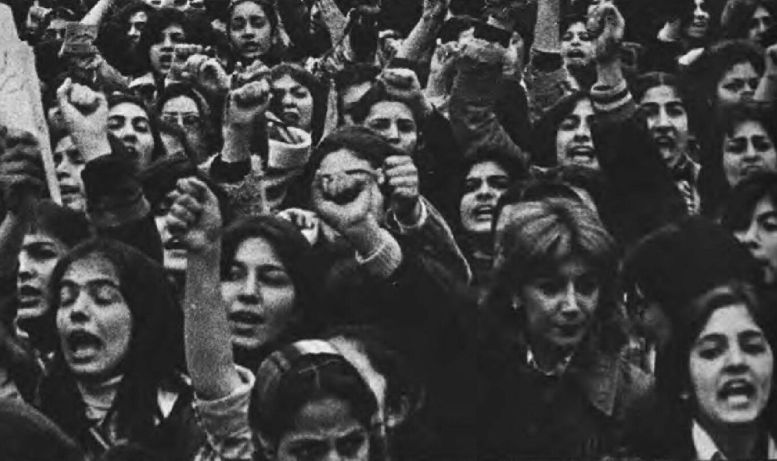
Khomeini could not immediately establish a dictatorship. There was still a feeling of freedom and continued struggles. Hundreds of thousands of women marched on International Women’s Day 8 March 1979 against the introduction of compulsory wearing of the hijab. This forced Khomeini into a temporary retreat. Continued strikes pushed through further nationalisations.
Khomeini also used typical liberal puppets in his first governments, such as his first Prime Minister Bazargan, a liberal Islamist reformer.
A Marxist Program
How could the full counter-revolution have been stopped? In contrast to other forces, the international Marxists which published the British paper Militant (the forerunners of ISA), stressed the importance of an independent working-class political party and a revolutionary program.
This started with democratic demands. “A Marxist Socialist Party would begin with the demand for the freedom to organise, freedom of speech, freedom of elections, freedom of press and all the democratic rights which have been won by the workers of the West over generations of struggle”, Ted Grant wrote and continued “They would demand the 8-hour day, 5-day week, and a sliding scale of wages linked to prices. These would be linked with the demand for a revolutionary constituent assembly (…) for the expropriation of the corrupt gang which has controlled Iran for so long.”
A socialist program must be connected to struggle and action committees of workers, appealing to soldiers in the repressive forces to change sides and to the working class internationally for support.
Counter-Revolution
The first step by the counter-revolution was to retreat from promises of a constituent assembly. The 12-member “Guardian Council” from the 1906 constitution became an Islamist group with the right to overrule all decisions of the state. More importantly, the new regime first called for strikes to end and later made them illegal and started sending workers’ leaders to prison. To stem growing criticism from students, universities were closed for two years from April 1980.
Reactionary Islamist laws were gradually introduced and nationalist propaganda dominated. This reached a new level when Iraq attacked Iran and the 8-year war started. The war consolidated the dictatorship of the mullahs when society was militarised, with a full dictatorship in place from June 1981. Mass executions became the signature of the regime, with a focus on left-wing and workers’ organisations. The resistance of the remaining left was confined to “armed struggle”, some of them even allying with Saddam Hussein’s Iraq.
The outcome of the revolution 1979 was far from inevitable. The strength of a rapidly-radicalising working class was evident – overthrowing the Shah and shaking global capitalism and imperialism. The absence of a mass workers’ party with a revolutionary program gave space to the Islamists. Since 1979, Iran has seen multiple historic mass movements challenging the Islamist capitalist dictatorship. This tradition is still there, even in the present situation of imperialist war attacks and with the dictatorship still in power.