Per-Åke Westerlund and Vincent Kolo, ISA International Political Committee
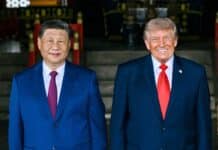
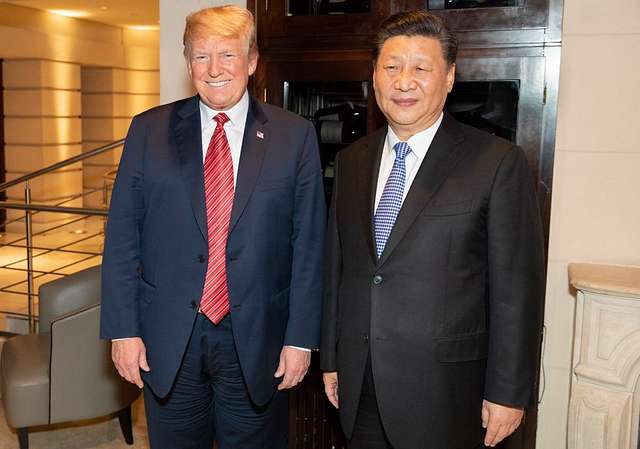
On 14-15 May, Xi Jinping and Donald Trump, the leaders of the two major imperialist powers, met in Beijing. This was the “stalemate summit” as some media described it, high on ceremony but almost wholly lacking in concrete results. Trump described the meeting as “incredible”, “a historic moment”, full of “fantastic deals” – his trademark hyperbole.
In reality the summit did not resolve any of their fundamental differences and saw both regimes talk past each other, addressing their own respective audiences. The US and Chinese readouts from the meeting differ significantly. The White House readout does not mention Taiwan at all, while it features heavily in the Chinese version. Most capitalist commentators seem relieved just that the meeting happened and avoided any sharp clashes.
Thus the fragile truce between the two regimes agreed at a brief meeting in Busan, South Korea, last October survives for now. But for how long is another question. The Busan agreement, under which current tariff levels are to be left unchanged, runs until this November. At the Beijing summit, Xi’s officials wanted to extend this until the end of Trump’s presidency in 2029, but the US refused, with Trump’s officials wanting to keep greater leverage in the run up to Xi’s return visit to the US in September.
Both sides want a breathing space, but this should not be misinterpreted as the end of their conflict, which spans economic and trade issues, geopolitics, technology and military rivalry – in short, global power. They have opted for de-escalation now in order to prepare for future maneuvers, knowing this is a long conflict and that new storms, crises and escalation are inevitable.
For US imperialism and Trump, who has bitten off too much in Iran, the next likely moves will be designed to continue its quest for increased control over the Western hemisphere from Venezuela and Panama to Cuba and Greenland. This is to give it a stronger base, it calculates, with which to overpower Chinese imperialism’s global economic and geopolitical challenge.
Xi’s regime is trying to build up its defenses through massive investments in AI and advanced technology and by going all out for technological “self-reliance”, in order to face the inevitable resumption of ferocious struggle with the US.
The Beijing meeting took place just over a year after Trump ramped up the US trade war to a new level, leading to 145 percent tariffs on Chinese goods. Beijing retaliated like for like and trade between the two countries was on its way down to zero. A financial collapse looked imminent, with sharp drops in stock and bond markets. Trump then did a “TACO” in May 2025, “temporarily” lowering the tariff rates and offering negotiations.
While the CCP dictatorship publicly showed defiance, behind the scenes it was every bit as desperate as the Trump regime to navigate away from the total collapse of US-China trade. This risked the loss of jobs for tens of millions of factory workers in China and threatened to push the already weak Chinese economy into a 1930s-scale depression.
Still, despite the climb down, the trade war has exacted huge costs on both economies. China’s exports to the US have fallen by 43 percent in value (from $538.5 billion to $308.4 billion) since 2018, when Trump’s first US-China trade war was unleashed. Last year, Chinese exports to the US shrank by 29.7 percent from 2024. The truce agreed in October, puts US tariffs on Chinese goods at about 47 percent and Chinese tariffs on US goods at about 30 percent, according to the Peterson Institute for International Economics.
Trump’s aggressive imperialism
In our perspectives documents and discussions, ISA foresaw this decoupling process as a result of the imperialist rivalry and confrontation between Washington and Beijing. The Xi-Trump meeting in Beijing changed almost nothing in this trade war. Meanwhile, the whole world has been shaken as Trump’s aggressive militarist brand of US imperialism rolls out, the main aim of which is to push back and undermine Chinese imperialism.
Since Trump and Xi met in South Korea last year, the US has attacked Venezuela and Iran and ramped up its pressure on Cuba. Venezuela under Nicolás Maduro was Beijing’s closest ally in Latin America. Now the Venezuelan government is taking its orders from Trump and the White House. The Iranian regime is a close ally to Russia, but also to Beijing.
Xi’s regime has only been able to offer muted help to its allies. Of course, China is secretly sending some weapons and military components to Teheran and issuing verbal protests in diplomatic forums like the United Nations. But China’s help to Iran is more limited even than for Russia’s war in Ukraine – because the CCP fears openly defying the US and Trump on this issue. Similarly, it has been confined to verbal protests in the case of Cuba, where the threat of a US military attack is increasing.
The CCP regime has not been able to extract major advantages from Trump’s Iranian fiasco, aside from the optics of looking more stable and ‘responsible’ than Trump’s regime. While Xi would be happy for the US to get bogged down in a new Middle Eastern quagmire, one that has already checked some of its military swagger, the economic spillover effects are serious for China.
The war means US military power has to be pulled back from East Asia, easing pressure on China. Expecting a quick victory over Iran, which has not happened, US imperialism must now contend with a more substantial diversion of its military power away from the Indo-Pacific. This is straining relations with its allies such as Japan’s Takaichi, who was the first foreign leader to be phoned by Trump immediately after his China visit. It is also causing consternation among China hawks in the US. Washington has recently told both Japan and Taiwan it must cancel or “delay” proposed arms shipments because the Iran war has drained its stockpiles.
Japan’s order for 400 Tomahawk missiles, due to be delivered in 2028, may be held up “for up to two years”. This offers a morsel of good news for Xi Jinping, who according to the Financial Times, launched a tirade during the summit with Trump against Takaichi and Japan’s re-militarisation that took US officials aback.
But the CCP is also trapped in a dilemma. The economic blowback from the Iran war and global energy crisis, while only beginning, has already affected the Chinese economy. Due to its huge and growing dependence on exports, Beijing urgently wants to see an end to the war and ‘normalisation’ of the situation in the Strait of Hormuz, in the hope that a global recession can be averted.
Why did they meet?
Given the sharp divergence of interests between the two imperialist superpowers, what was the point of the summit? Trump already cancelled his visit once, in April, “due to the war”. With no real outcomes likely, what did either side have invested in this meeting – and a further three Xi-Trump meetings planned in 2026?
A key factor is that both regimes are dealing with respective internal crises. They therefore lean on each other. They want to avoid an escalation of their trade and other conflicts if possible and portray themselves as ‘responsible’ world leaders. Trump has even revived the term “G2” (Group of Two) to describe the dynamic between himself and Xi. In a year so far dominated by US military attacks, Xi told the summit that, “the great rejuvenation of the Chinese nation and making America great again can be done in parallel, mutually beneficial, and for the benefit of the world.”
These are both regimes in deep crisis. Trump wanted a foreign policy ‘success’ to distract from his Iran disaster. Both leaders sought an opportunity to increase their standing and prestige at home. For Xi Jinping this is particularly acute, even if he does not face elections as Trump’s party does in November. Xi continues to be locked in a ferocious life-and-death internal power struggle to secure a fourth term as CCP leader.
The Xi faction’s arrest of top general Zhang Youxia, who has not been seen since January and may be dead, has not yet brought about a conclusive win for their camp. Other sectors of the ‘party-state’ machinery continue to resist and obstruct. Zhang has still not been formally removed from his positions – a prerequisite for a formal criminal investigation to begin. There are continued signs of unrest within the PLA.
In an unprecedented wave of purges since 2022, more than 100 senior officers have been removed, arrested or disappeared. Inevitably, this limits the CCP’s military readiness for the foreseeable future. One week prior to Trump’s visit came the announcement of abnormally harsh suspended death sentences for two former defence ministers, which were conspicuously coordinated (the two cases were separate). This was a warning from Xi’s camp as it struggles to reassert control over the PLA.
The struggle within the CCP-state comes on top of the world’s biggest property crisis ever, with house prices in China falling by twice as much as in the US crisis of two decades ago. This year, China is grappling with record levels of unemployment, factory closures, worsening poverty, and the “large scale” return of migrant workers to their rural hometowns due to the lack of jobs and high costs of city life.
For Trump, his military aggression against Iran has precipitated a major crisis including on the cost of living, following the important defeat in Minneapolis in January, with the mass strike against “Trump’s private army” ICE. Both regimes face extreme levels of debt and fiscal deficits.
This explains Trump wanting a time out from his incendiary election campaign language about China “raping” the US. Mirroring this transformation, Xi has put a gag on China’s wolf warrior diplomats (ultra-nationalists) and outwardly at least returned to Deng Xiaoping’s maxim: “hide your strength and bide your time”. In both cases this more reasonable tone is false and temporary. New flare-ups in the conflict between the two powers are inevitable because it is rooted in the nature of imperialism – a stage of capitalism in deep crisis – rather than in the outlook of individual political leaders.
With US power suffering a serious setback in Iran and China’s debt-driven capitalism unable to openly challenge it, there is a deadlock. The two leaders want to be seen as indispensable within their own camps and seem to have temporarily reached a precarious understanding.
The announcement that Xi will visit Washington on 24 September should be seen in this light. It is very rare to announce an exact date so far in advance, but for both leaders this is an attempt to strengthen their respective positions against a fixed timeline of the US midterm elections in November and the CCP’s 5th plenum, likely to be held before September.
Saving face
Trump brought a big delegation including 18 CEOs with a combined net worth of $1.2 trillion. The nexus of Wall Street, Silicon Valley and the state was clear. Secretary of War Pete Hegseth was in the delegation. The last time a US defence secretary accompanied a president to China was in 1972, the historic ice-breaking visit of Richard Nixon.
Marco Rubio was also there and shook hands with Xi Jinping, noteworthy because the current US Secretary of State and National Security Advisor is sanctioned by the CCP and officially barred from entering China. To square this circle, the Chinese side changed the transliteration of Rubio’s name to “Lu”-bio. A Chinese foreign ministry spokesperson also told reporters that the sanctions, linked to Xinjiang and Hong Kong policies, applied to Senator, not Secretary, Rubio.
The CCP’s media (China’s media is state-controlled) reduced its coverage of the Trump state visit, compared to his 2017 visit. The summit did not make the front page of People’s Daily, which was devoted instead to essays on “combating formalism” and “red genes”. The low-key coverage was to reduce the level of embarrassment for Xi, who built his nationalist strongman image on perceived toughness towards the US. Yet here he was honoring Trump, the violator of pro-China regimes in Venezuela, Iran and Cuba, with full red carpet treatment. For China’s Little Pinks, the equivalent of Trump’s MAGA movement, this was outrageous. Numerous posts (soon deleted) denounced Xi Jinping’s “softness” towards Trump.
What was agreed?
The summit began with low expectations which were duly met. What was decided upon were some vague structures: A US-China Board of Trade and a parallel Board of Investment. The White House called them “cornerstones of this historic agreement”, but only one of them is likely to have any role and a modest one at that.
The Board of Trade is supposed to discuss “non-sensitive goods” and could lead to around $30 billion of tariff reductions for each side. Treasury Secretary Scott Bessent said it meant Chinese products the US does not want to produce, for example fireworks, could have lower tariffs. The role of the US-China Board of Investment is even more unclear, but like the trade board it will only deal with non-controversial investments.
Xi’s regime offered some sweeteners which came as no surprise such as an agreement to buy 200 Boeing planes – a number that disappointed Wall Street. So-called market expectations were for 500 planes, and Trump had even spoken of 750. While this is the first Boeing order from China for almost a decade, these planes can also become ‘hostages’ in future rounds of heightened trade war, as with everything else on the table at the Beijing summit.
Furthermore, China’s aviation industry is trapped in a crisis of oversupply (like the economy at large) with big Chinese airlines in the red, slashing routes, fighting price wars, and facing severe competition from the country’s vast and half-empty high-speed rail network. These problems are now exacerbated by the global energy crisis centred on the Strait of Hormuz.
On farm products including soybeans, the White House says China will purchase $17 billion worth for each of the next three years. If fully realised, this would still leave China’s farm imports from the US “below historical peaks” according to Reuters.
For its part, Xi’s team pushed for “constructive strategic stability for three years and beyond”, a timeline clearly focused on the period with Trump in the White House and above all Xi Jinping’s own position, with the decisive CCP Congress next year (2027). The idea is to lock in the current unstable inter-imperialist truce, which Xi can present as a win, strengthening his hand in the internal CCP power struggle.
Thucydides
In his talks with Trump, Xi referenced the “Thucydides Trap”, alluding to US decline – “elegantly” – according to Trump. This is a point Xi has raised on four occasions with US presidents, including during his final meeting with Joe Biden in 2024. The “trap” refers to Athens challenging Sparta, 2,400 years ago. Thucydides was an Athenian historian and military leader. The punchline to Xi’s argument was ostensibly the need to avoid a US-China war. But the additional meaning, which was intended for his domestic audience, was to repeat in front of the visiting Americans one of his favourite slogans: “the East is rising and the West is in decline”. However, as we have explained this narrative is flawed. While it is clear that the “west” i.e. western and US capitalism is in decline, China and “eastern” capitalism is also trapped in an inescapable crisis.
Trump claimed he and Xi Jinping were united over the Iran war. He said Xi had assured him that China will not send weapons to Iran, it wants to open the Strait, and agrees that Iran should not have nuclear weapons. All of this is completely empty, yet features heavily in the Trump regime’s propaganda from the summit.
In fact, whatever Xi tells the Americans, China will continue to send so-called dual use components to Iran, and even weapons, but surreptitiously and through third parties. The US side knows this because it has done exactly the same in many situations.
As for nuclear weapons, even the Iranian regime itself officially says it does not aim for nuclear arms. This was also the crux point of the 2015 deal agreed between Iran, Obama’s US, and China being one of the signatories. Therefore the official CCP position that Iran should not develop nuclear weapons is unchanged, which is also its official position towards North Korea, although in practice as a counter to US-led military and economic pressure on China, the CCP has quietly dropped “de-nuclearisation” in the case of Korea.
As explained, for its own economic interests the Xi regime prefers the Strait of Hormuz to reopen and the war to end. Beijing also needs to safeguard its economic ties with Saudi Arabia and the Gulf states, which are six times larger than with Iran. These regimes are of course against Iran getting a nuclear bomb. We have also already seen how the CCP is unable to militarily support ‘pro-China’ regimes and allies at the risk of direct confrontation with US imperialism, which would endanger the shaky trade truce.
A shift over Taiwan?
The announcement by the US one week after Trump left China that it would “pause” a proposed $14 billion arms package to Taiwan has unnerved the island’s government and other US-allies in Asia. Whereas in South Korea a half-year ago, Xi surprisingly did not mention Taiwan at all, it was fully reinstated at the Beijing summit. Xi told the US side that the “Taiwan question” was the most important and could lead to “conflict” if badly managed, although there was nothing new in these comments. This was the key issue for Xi, to show firmness and cover up his concessions to Trump in other fields.
There has nevertheless been speculation that Trump might have agreed to concessions over Taiwan in private talks with Xi. On the $14 billion arms package, to include Patriot interceptors and HIMARS, Trump told reporters he had discussed this with Xi, which is a break with US precedent since 1982. Another arms package to Taiwan worth $11 billion, which was the biggest ever, was approved by Trump in January.
Prior to the summit, the Chinese regime pushed for diplomatic gestures from Trump such as stopping arms sales and changing the US position of “not supporting” Taiwan independence to “opposing” independence. In subsequent media interviews, Trump said he had given no commitments to Xi Jinping, and had not yet decided on the arms package to Taiwan. It is his remark, after the visit, that the arms package makes a “very good negotiating chip” that has created the biggest stir and potential crisis in US Taiwan policy.
In highly publicised remarks to Fox News Trump said, “I’m not looking to have somebody to go independent and, you know, we’re supposed to travel 9,500 miles to fight a war… I’m not looking for that. I want them to cool down. I want China to cool down.”
The actual distance from the US to Taiwan is roughly the same as to Iran, but aside from this geography error Trump’s statement does not stray from established US policy. US officials, with Rubio to the fore, have stressed there is “no change” in Taiwan policy. Risking further pandemonium, Trump twice said he would make a phone call to the “person running Taiwan”, meaning president Lai Ching-te. No US president has ever done so and this would be crossing a red line that Xi’s regime could not ignore, truce or no truce.
Do these moves signal that Trump is preparing to “sell out” Taiwan for a deal with the CCP? While that cannot categorically be ruled out, it is highly unlikely. The issue is bigger than the personal inclinations of a president, even a Bonaparte like Trump. More likely, he thinks he can play off both sides to gain concessions, which in Taiwan’s case could mean increasing its investments in the US tech sector.
US policy on Taiwan for half a century, with its “six assurances” and “strategic ambiguity”, is based on its position as the crucial chess piece in a string of alliances that enable US imperialism to project military power dominance across East Asia. As we explained: “The loss of Taiwan – its subjugation by the Beijing regime – would represent a historic defeat for US imperialism with far greater repercussions than its humiliation in the Vietnam war.” [What’s behind the Taiwan Strait crisis? August 31, 2022]
While it may not be the whole explanation, the Iran war and staggering depletion of US weapons stocks is a major reason for delaying or freezing the Taiwan deal, as with the delayed arms shipments to Japan. This can be reversed at a later stage. Trump has sent more weapons to Taiwan than any other US president (so far totalling $29.7 billion). A lesser known fact is the accumulated backlog of between $20-30 billion worth of US-made arms already contracted to the island, due to delivery delays of up to five years for some weapons.
Therefore, so far at least, this is not a major turn by Trump on the Taiwan question. Previous US presidents have postponed arms sales to Taiwan, although not in the recent era of heightened US-China standoff. President George W. Bush froze arms sales to Taiwan in 2004-2005 to exert pressure on its DPP government and avoid a military escalation with China during the US ‘War on Terror’.
Still, as always with Trump’s wild policy swings and brinkmanship, the latest maneuvers over Taiwan will produce real and possibly long-lasting effects in Taiwan and East Asia. The CCP’s propaganda machine has seized on the arms deal u-turn in its so-called cognitive warfare aimed at the Taiwanese, that they can “never trust” the US. This idea gets a much bigger echo today. Thousands marched in Taipei on 23 May, mobilised by NGOs and groups aligned with Lai’s DPP government, to support his militarist spending plans.
Peace and security in the Taiwan Strait and in East Asia as a whole is under constant threat as long as capitalism and imperialism survive. None of the capitalist parties and governments – in China, Taiwan, the US and beyond – offer any solution, which requires the overthrow of capitalism through revolutionary working class struggle.
“Strategic stability”?
While the truce between the two superpowers survives, there is no stability, strategic or otherwise. Deep mutual suspicion and enmity hide behind the fake friendliness. The US delegation was filmed dumping all the gifts they received in China into a dumpster as they boarded the presidential jet for the journey home. Nothing from China was allowed on Trump’s plane, ostensibly due to fears of spying devices.
While claiming they will take steps to increase trade, both sides are investigating new measures to use against each other. On critical minerals and rare earths, where China’s dominance is a ‘choke point’ potentially more powerful than Iran’s hold over the Strait of Hormuz, the global struggle will continue, with US imperialism frantically trying to bring alternative sources into play.
For now, US imperialism continues to enjoy military and financial dominance. The challenge from Chinese capitalism comes from its superior industrial capacity and export machine. War and the respective crises of the two superpowers will create new twists and confrontations. Both Washington and Beijing are suffering geopolitical setbacks, with allies pulling away or being lost (for the US in Europe, for the CCP in Latin America and the Middle East). Both regimes face internal upheavals and crises and fear the working class and its potential more than anything else.